

WeGreened Approval Statistics: Week of August 25, 2025
During the week of August 25 to August 31, 2025, WeGreened received a total of 78 approval notices from the United States Citizenship and Immigration Services (USCIS). The EB-2 National Interest Waiver (NIW) category continued to dominate approvals, representing the majority of cases, while the EB-1A (Alien of Extraordinary Ability) category maintained a strong presence among accomplished researchers and professionals.
Approval Distribution by Category and Service Center
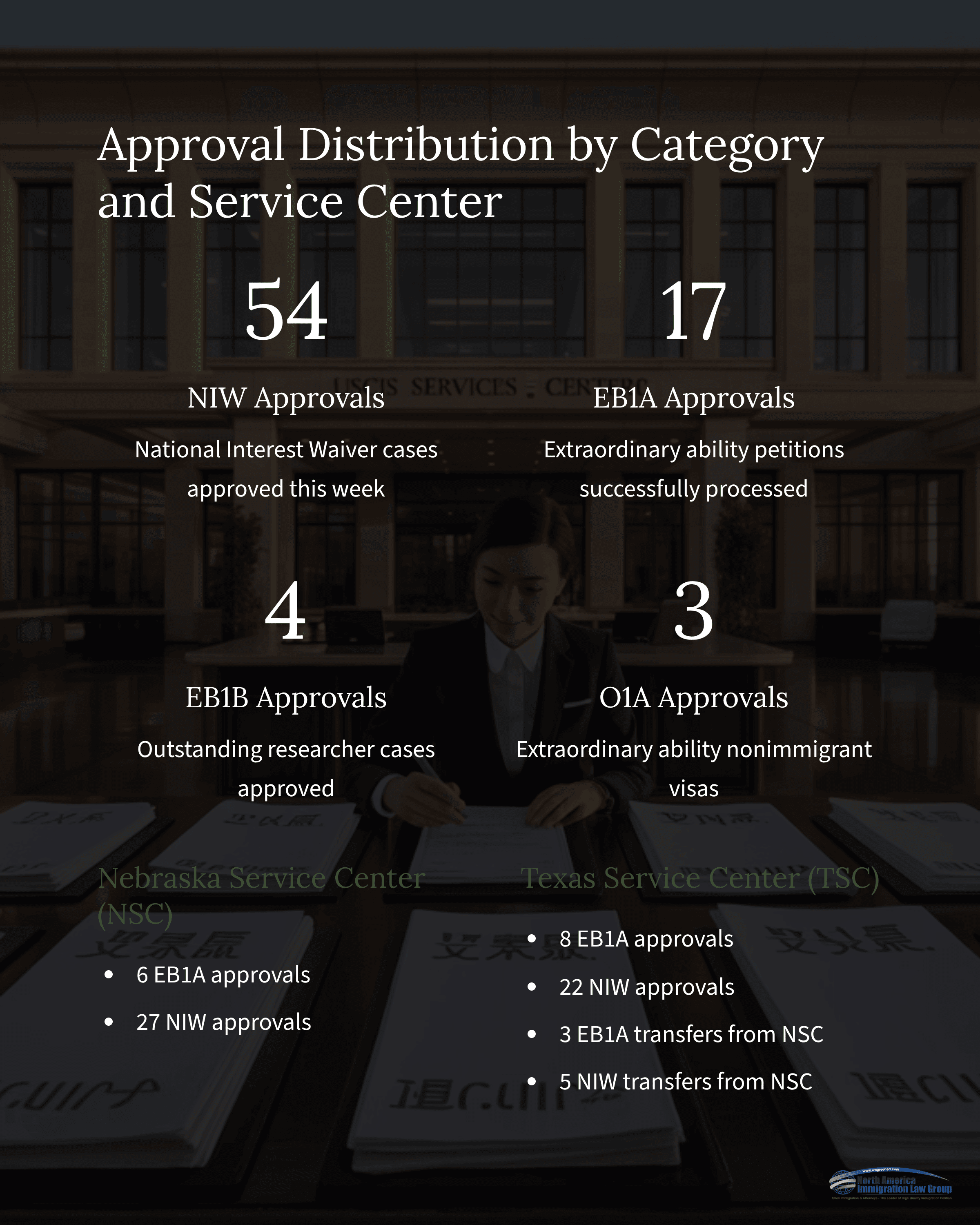
Of the 78 approvals, 54 were for NIW, 17 for EB1A, 4 for EB1B, and 3 for O-1.
The Nebraska Service Center (NSC) processed 6 EB1A and 27 NIW approvals, while the Texas Service Center (TSC) handled 8 EB1A and 22 NIW approvals. Additionally, 3 EB1A and 5 NIW cases were transferred from NSC to TSC.
EB1A and NIW Credential Analysis
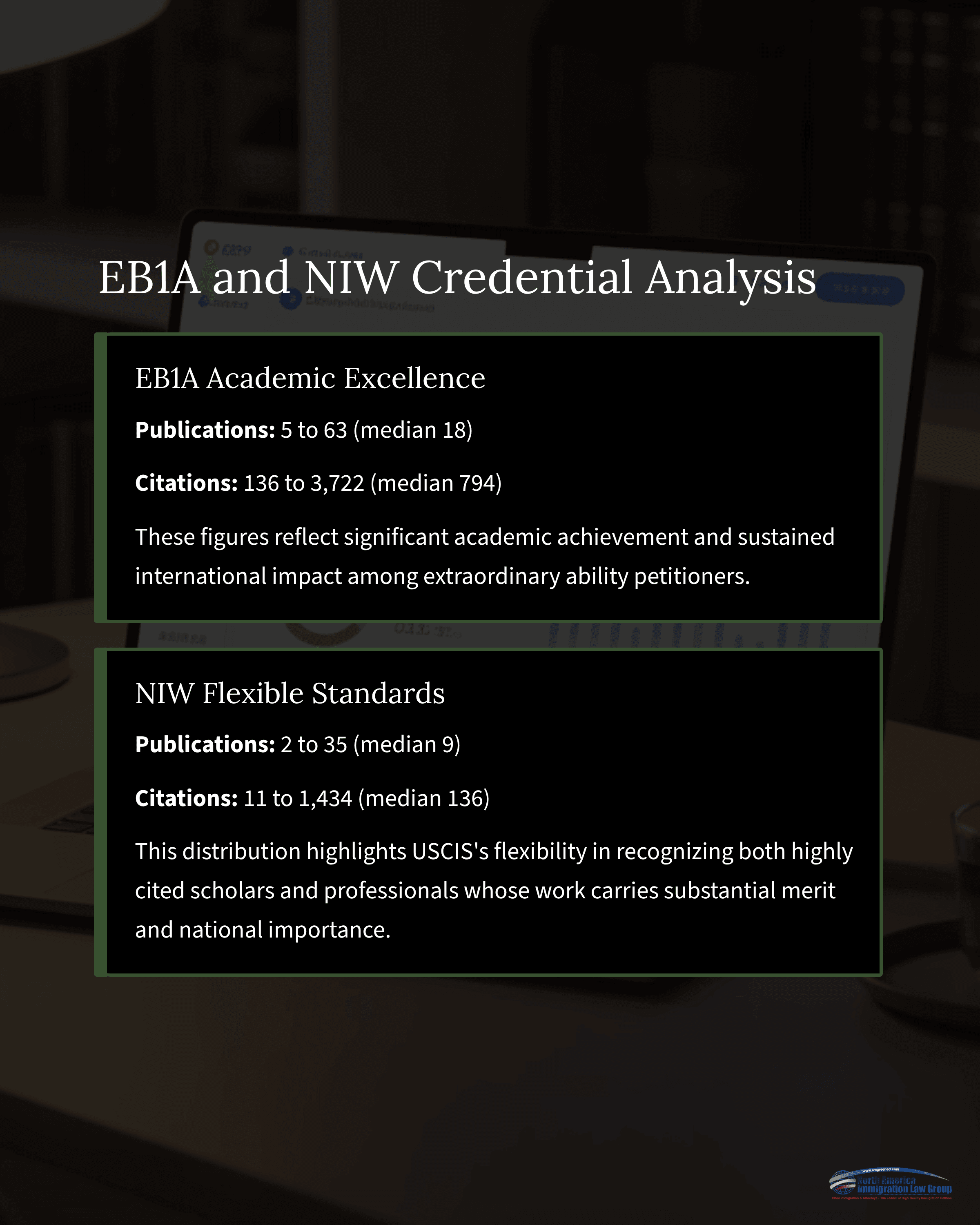
EB1A petitioners demonstrated strong scholarly productivity, with publications ranging from 5 to 63 (median 18) and citations between 136 and 3,722 (median 794). These figures reflect significant academic achievement and sustained international impact.
NIW petitioners showed a broader range of academic profiles, with publication counts from 2 to 35 (median 9) and citations between 11 and 1,434 (median 136). This distribution highlights USCIS’s flexibility in recognizing both highly cited scholars and professionals whose work carries substantial merit and national importance.
Insights on Petitioner Backgrounds and Fields
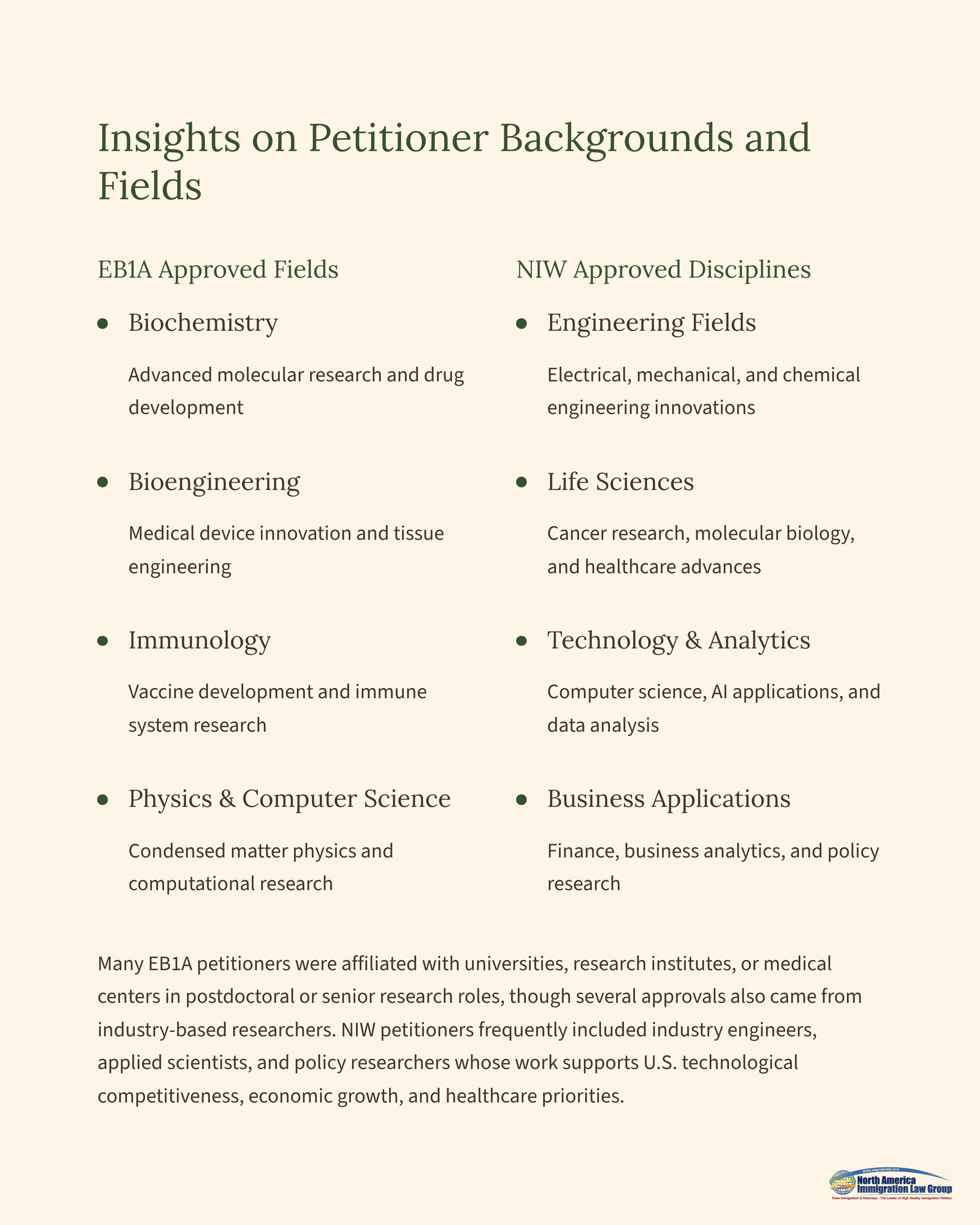
EB1A approvals this week included petitioners in biochemistry, bioengineering, immunology, experimental condensed-matter physics, and computer science. Many were affiliated with universities, research institutes, or medical centers in postdoctoral or senior research roles, though several approvals also came from industry-based researchers.
NIW approvals spanned a wide variety of disciplines, including electrical, mechanical, and chemical engineering, computer science, chemistry, and cancer and molecular biology, as well as select areas in finance and business analytics. Petitioners frequently included industry engineers, applied scientists, and policy researchers whose work supports U.S. technological competitiveness, economic growth, and healthcare priorities.
Highlighted Non-STEM Case
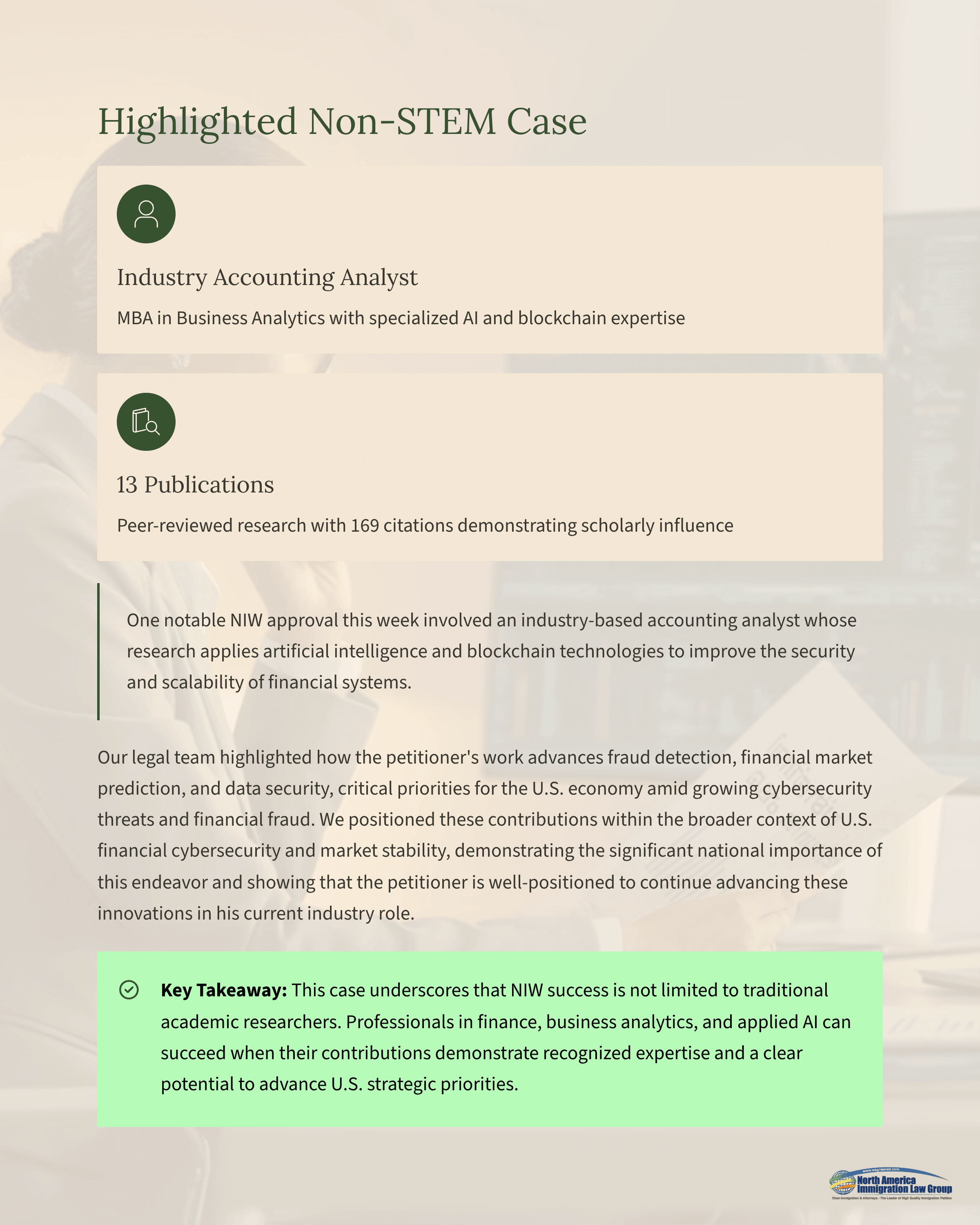
One notable NIW approval this week involved an industry-based accounting analyst whose research applies artificial intelligence and blockchain technologies to improve the security and scalability of financial systems. Holding an MBA in Business Analytics, the petitioner has authored 13 peer-reviewed publications with 169 citations, demonstrating recognized expertise and scholarly influence in this specialized area.
Our legal team highlighted how the petitioner’s work advances fraud detection, financial market prediction, and data security, critical priorities for the U.S. economy amid growing cybersecurity threats and financial fraud. We positioned these contributions within the broader context of U.S. financial cybersecurity and market stability, demonstrating the significant national importance of this endeavor and showing that the petitioner is well-positioned to continue advancing these innovations in his current industry role.
This case underscores that NIW success is not limited to traditional academic researchers. Professionals in finance, business analytics, and applied AI can succeed when their contributions demonstrate recognized expertise and a clear potential to advance U.S. strategic priorities.
Adjudication Trends and Policy Observations
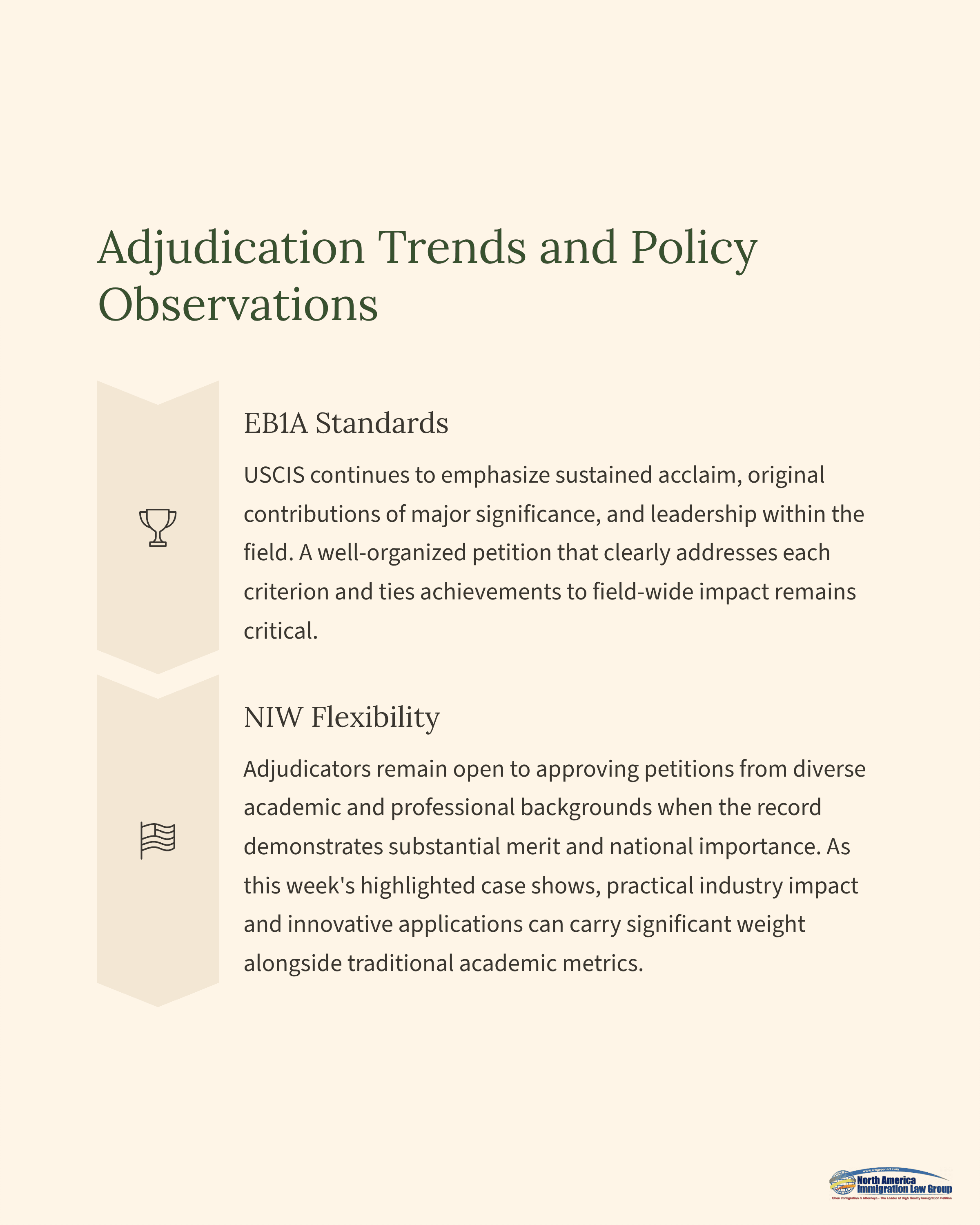
EB1A: USCIS continues to emphasize sustained acclaim, original contributions of major significance, and leadership within the field. A well-organized petition that clearly addresses each criterion and ties achievements to field-wide impact remains critical.
NIW: Adjudicators remain open to approving petitions from diverse academic and professional backgrounds when the record demonstrates substantial merit and national importance. As this week’s highlighted case shows, practical industry impact and innovative applications can carry significant weight alongside traditional academic metrics.