
WeGreened Approval Statistics: Week of December 8, 2025
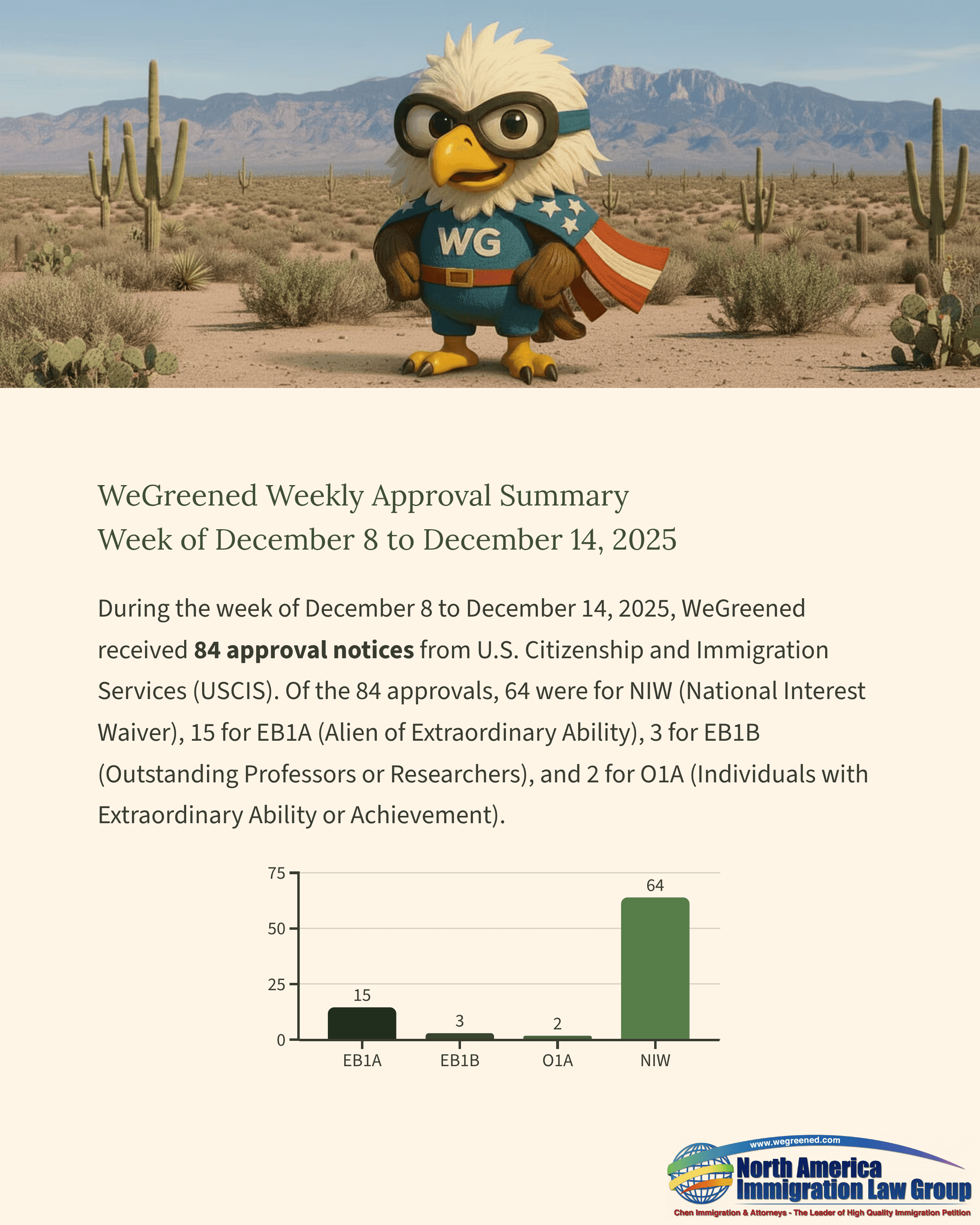
During the week of December 8 to December 14, 2025, WeGreened received 84 approval notices from U.S. Citizenship and Immigration Services (USCIS). Of the 84 approvals, 64 were for NIW (National Interest Waiver), 15 for EB1A (Alien of Extraordinary Ability), 3 for EB1B (Outstanding Professors or Researchers), and 2 for O1A (Individuals with Extraordinary Ability or Achievement).
The EB-2 NIW category again represented the majority of approvals, while EB-1A remained strong among highly accomplished researchers, clinicians, and industry professionals.
EB1A and NIW Credential Analysis
EB1A petitioners showed concentrated impact metrics. Publications ranged from 6 to 111 (Q1: 10.5, median: 14, Q3: 26.5), and citations ranged from 125 to 14,252 (Q1: 401.5, median: 653, Q3: 1,373). EB1A approvals were overwhelmingly STEM-coded, and most petitioners held doctoral or professional degrees.
NIW petitioners reflected a broader spectrum of profiles. Publications ranged from 1 to 45 (Q1: 6, median: 9, Q3: 15.5), and citations ranged from 5 to 2,592 (Q1: 57.75, median: 136.5, Q3: 397.5). About two-thirds of NIW petitioners held doctoral or professional degrees, most others held master’s degrees, and NIW approvals were primarily STEM-coded.
Insights on Petitioner Backgrounds and Fields
EB1A approvals this week clustered most heavily in life sciences/medicine and computer science/AI/data, typically involving research-intensive roles such as research scientists, postdoctoral researchers, faculty, senior engineers, and some clinical or clinical-research physicians.
NIW approvals spanned a wider mix across AI/software, engineering, and biomedical/health sciences, with many petitioners working in industry and postdoctoral or research roles. Across the dataset, approvals aligned best with filings that clearly linked the petitioner’s work to measurable impact (EB1A) or to national importance and future benefit (NIW).
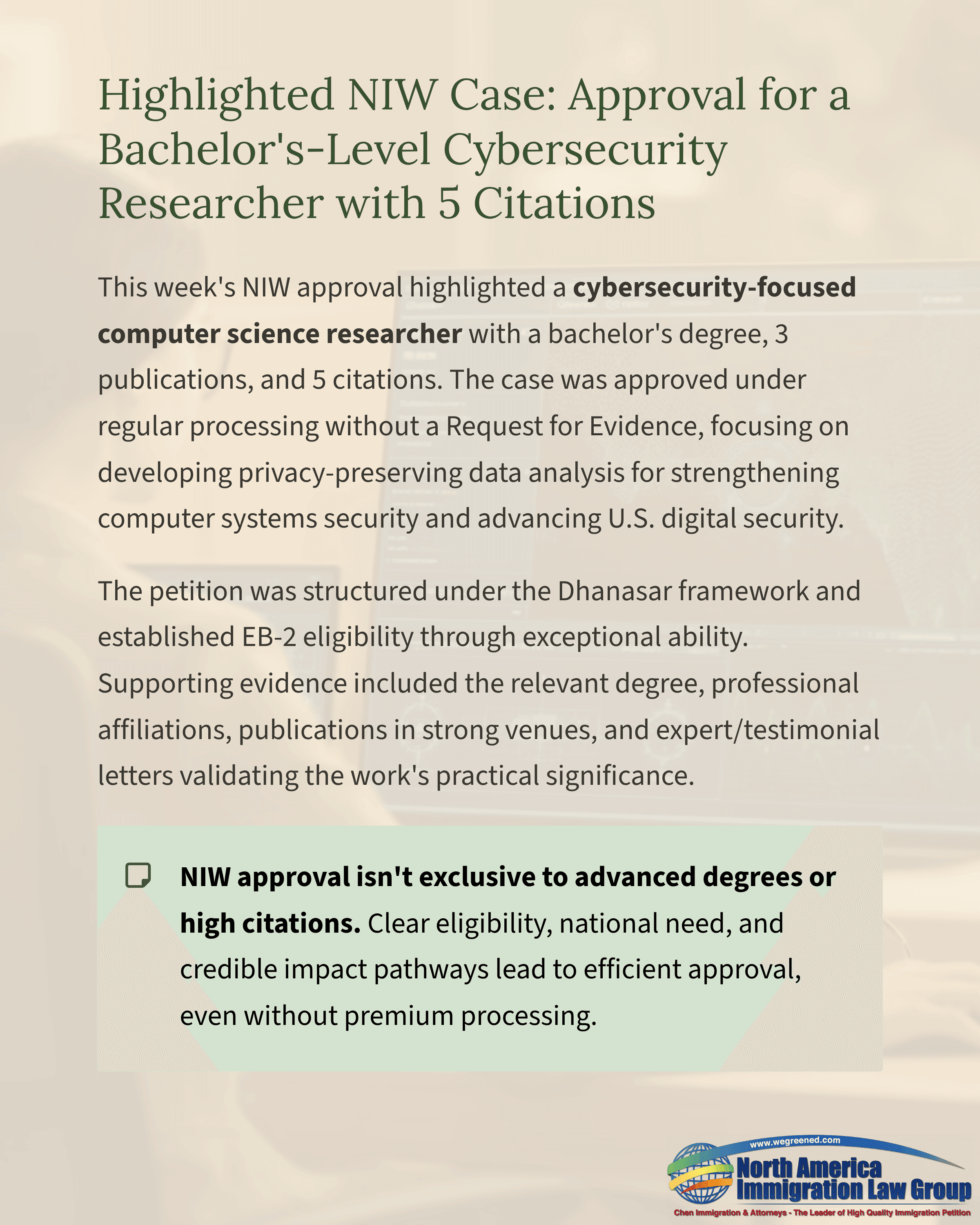
Highlighted NIW Case: Approval for a Bachelor’s-Level Cybersecurity Researcher with 5 Citations
This week’s highlighted NIW approval involved a cybersecurity-focused computer science researcher whose profile combined a bachelor’s degree with modest traditional metrics—3 publications and 5 citations—yet was approved under regular processing without a Request for Evidence. The proposed endeavor focused on developing computationally efficient, privacy-preserving data analysis approaches to measure strategic behavior and detect anomalies, positioning the work as directly relevant to strengthening computer systems security and advancing U.S. digital security priorities.
The petition was structured under the Dhanasar framework while also establishing EB-2 eligibility through exceptional ability. Supporting evidence included the relevant degree, professional affiliations, and peer recognition, including publication in strong venues, open-source contributions, and competitive research support. The filing tied the endeavor to concrete cybersecurity needs, demonstrated the petitioner was well positioned through a focused research record and signs of independent uptake, and explained how a waiver would enable broader dissemination and collaboration beyond a single employer. To provide field context and third-party validation, our firm prepared two expert recommendation letters and two testimonial letters tailored to the petitioner’s niche and the practical significance of the work.
This result reinforces that NIW approval is not limited to applicants with advanced degrees or high citation totals. When a petition clearly establishes eligibility, ties the endeavor to identifiable national needs, and documents credible pathways for continued impact, USCIS can approve efficiently even without premium processing.
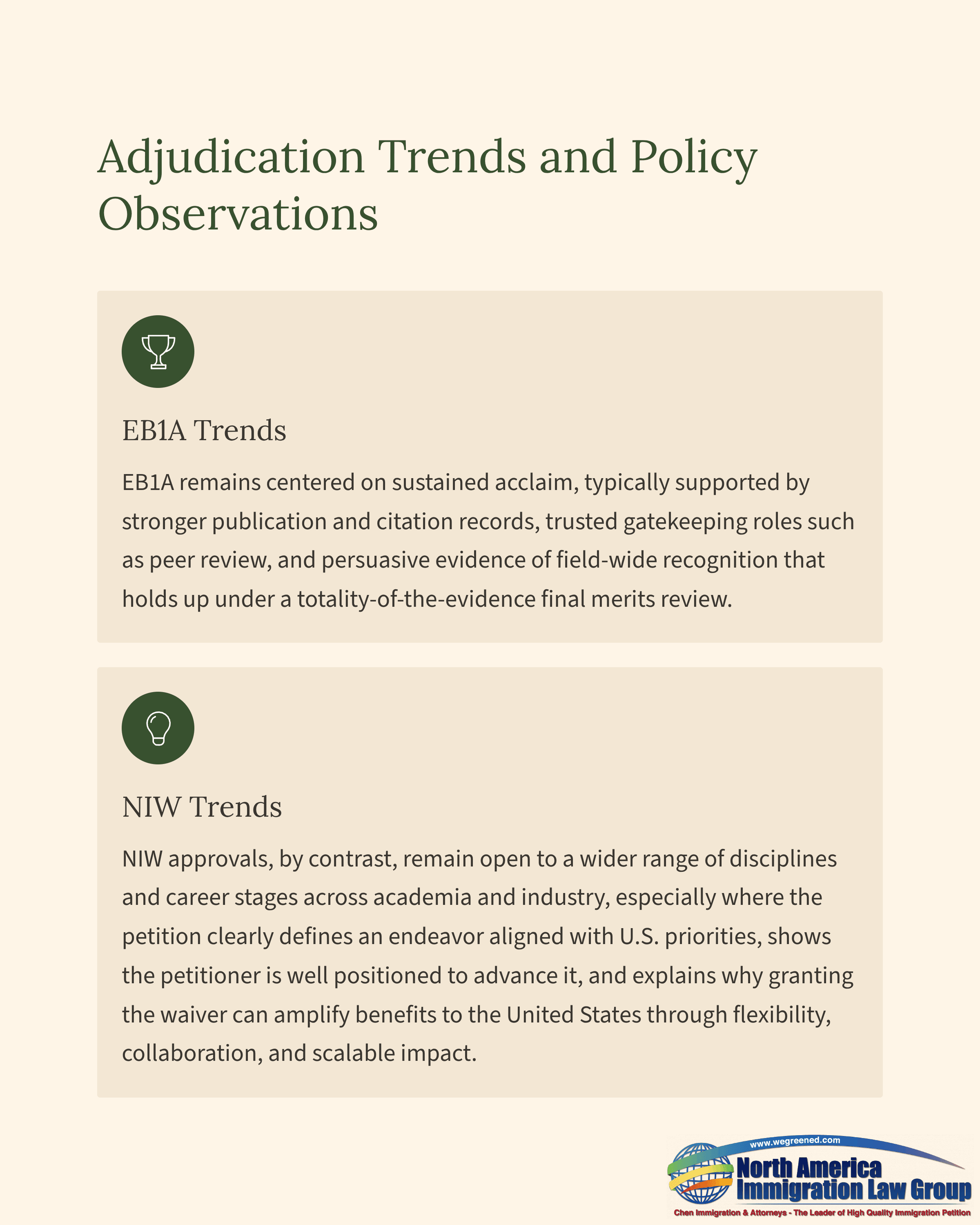
Adjudication Trends and Policy Observations
EB1A remains centered on sustained acclaim, typically supported by stronger publication and citation records, trusted gatekeeping roles such as peer review, and persuasive evidence of field-wide recognition that holds up under a totality-of-the-evidence final merits review.
NIW approvals, by contrast, remain open to a wider range of disciplines and career stages across academia and industry, especially where the petition clearly defines an endeavor aligned with U.S. priorities, shows the petitioner is well positioned to advance it, and explains why granting the waiver can amplify benefits to the United States through flexibility, collaboration, and scalable impact.