
WeGreened Approval Statistics: Week of November 10, 2025
During the week of November 10 to November 16, 2025, WeGreened received 64 approval notices from U.S. Citizenship and Immigration Services (USCIS). Of the 64 approvals, 43 were for NIW (National Interest Waiver), 19 for EB1A (Alien of Extraordinary Ability), 1 for EB1B (Outstanding Professors or Researchers), and 1 for O1A (Individuals with Extraordinary Ability or Achievement). The EB-2 NIW category again represented the majority of approvals, while the EB-1A category maintained a strong presence among accomplished researchers, clinicians, and industry professionals.
EB1A and NIW Credential Analysis
EB1A petitioners demonstrated strong scholarly productivity, with publications ranging from 7 to 108 (median 16) and citations between 193 and 16,179 (median 424). These figures reflect substantial academic achievement and international impact, with most EB1A approvals clustering in the mid-teens to low-thirties for publication counts and several hundred citations, and a few highly cited outliers in the thousands.
NIW petitioners showed a broader range of academic profiles, with publication counts from 2 to 103 (median 11) and citations between 24 and 3,072 (median 165). This distribution highlights USCIS’s flexibility in recognizing both well-established scholars and mid-career professionals whose work carries substantial merit and national importance, even when their citation counts are more modest than typical EB1A profiles. The majority of NIW petitioners held PhD or medical degrees, a substantial group held master’s-level credentials, and one notable case proceeded under the “bachelor’s plus five years of progressive experience” provision for EB-2 classification.
Insights on Petitioner Backgrounds and Fields
EB1A approvals this week spanned energy engineering, artificial intelligence and machine learning, food science, mechatronics and mechanical engineering, pediatric brain tumor research, synthetic organic chemistry, global health implementation science, computer vision, condensed matter physics, internal medicine, neurosurgery and neurological disorders, soil science, biotechnology, biomaterials, protein aggregation, statistical machine learning, and computational biology and bioinformatics. Many petitioners worked at universities and research institutes as Ph.D. candidates, postdoctoral fellows, research scholars, or assistant professors, while others served in senior technical roles in industry as research scientists, staff scientists, or senior scientists in oncology, drug discovery, and advanced computing.
NIW approvals covered computer science, artificial intelligence and generative AI, robotics, electrical, mechanical, civil, aerospace, industrial and production, and construction engineering, materials science and optical materials, biomedical and biomechanical engineering, neurovascular bioengineering, neuroscience, cardiology, anesthesiology, pharmaceutical sciences, healthcare analytics, agriculture, plant science and plant genetics, and social work and agricultural and resource economics, among others. Profiles frequently included Ph.D. students, postdoctoral researchers, assistant professors, research scientists, and industry engineers, along with clinicians and healthcare professionals whose projects align with U.S. priorities in healthcare, advanced manufacturing, supply-chain resilience, infrastructure, energy, agriculture, and emerging technologies.
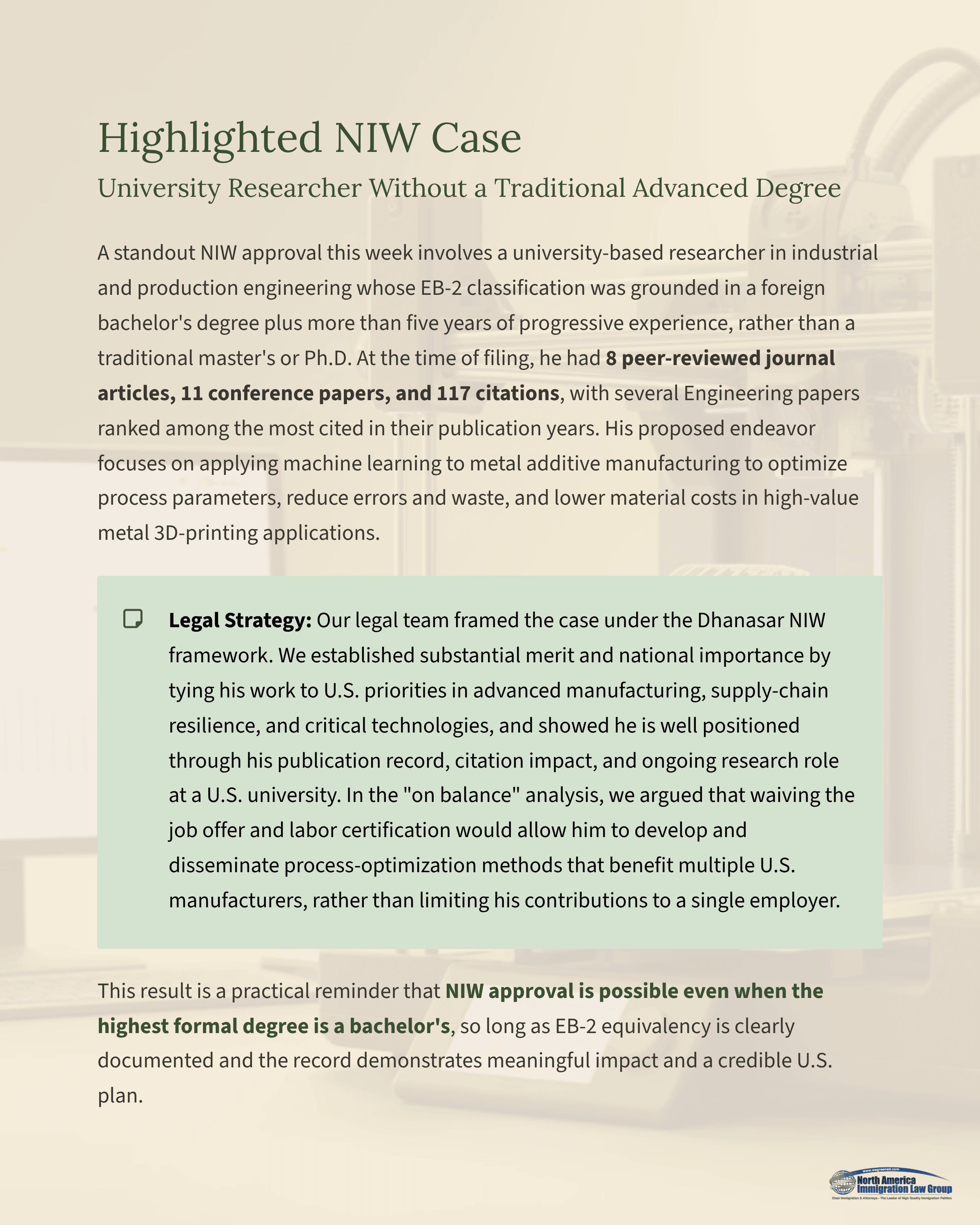
Highlighted NIW Case: University Researcher Without a Traditional Advanced Degree
A standout NIW approval this week involves a university-based researcher in industrial and production engineering whose EB-2 classification was grounded in a foreign bachelor’s degree plus more than five years of progressive experience, rather than a traditional master’s or Ph.D. At the time of filing, he had 8 peer-reviewed journal articles, 11 conference papers, and 117 citations, with several Engineering papers ranked among the most cited in their publication years. His proposed endeavor focuses on applying machine learning to metal additive manufacturing to optimize process parameters, reduce errors and waste, and lower material costs in high-value metal 3D-printing applications.
Our legal team framed the case under the Dhanasar NIW framework. We established substantial merit and national importance by tying his work to U.S. priorities in advanced manufacturing, supply-chain resilience, and critical technologies, and showed he is well positioned through his publication record, citation impact, and ongoing research role at a U.S. university. In the “on balance” analysis, we argued that waiving the job offer and labor certification would allow him to develop and disseminate process-optimization methods that benefit multiple U.S. manufacturers, rather than limiting his contributions to a single employer. This result is a practical reminder that NIW approval is possible even when the highest formal degree is a bachelor’s, so long as EB-2 equivalency is clearly documented and the record demonstrates meaningful impact and a credible U.S. plan.
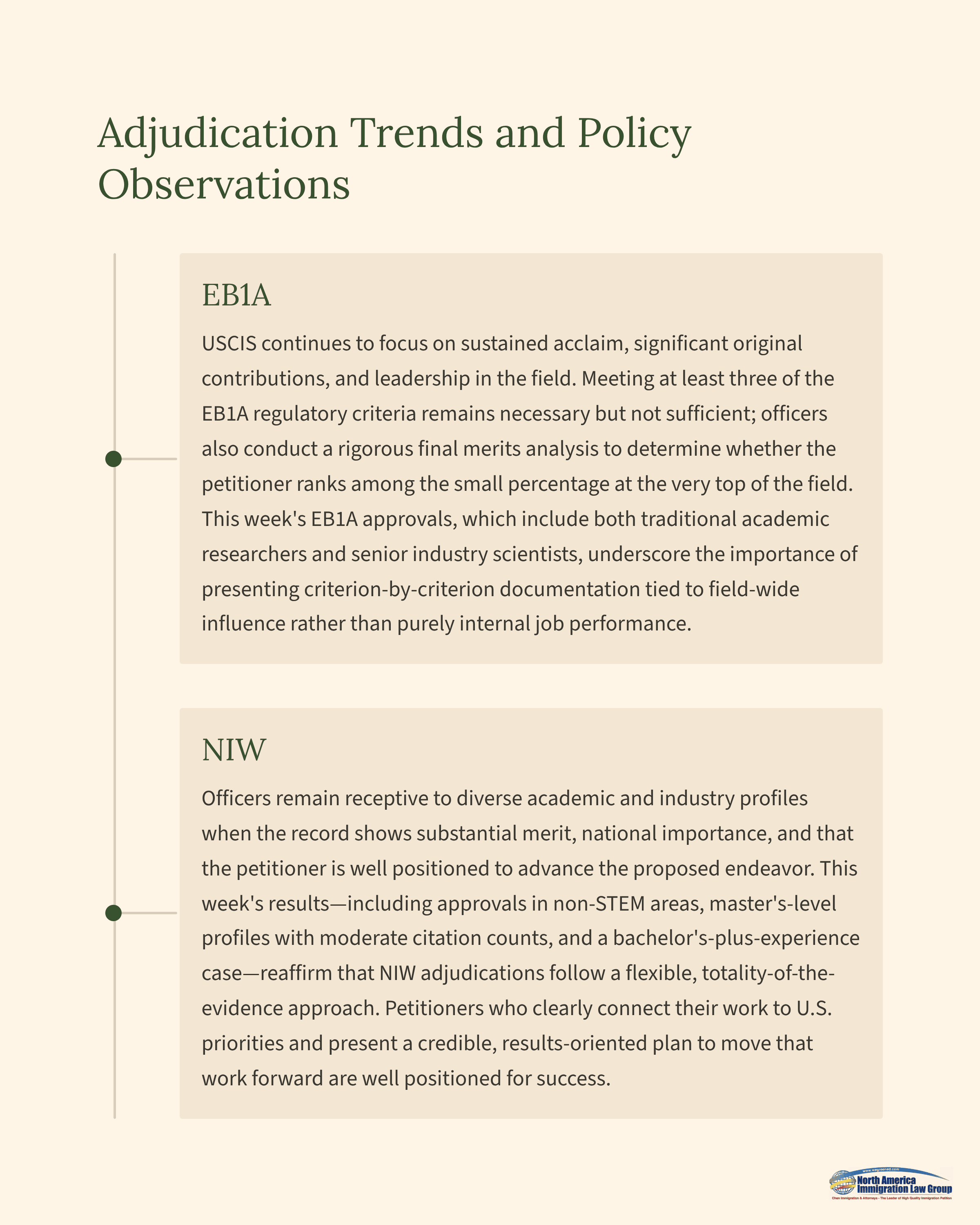
Adjudication Trends and Policy Observations
EB1A: USCIS continues to focus on sustained acclaim, significant original contributions, and leadership in the field. Meeting at least three of the EB1A regulatory criteria remains necessary but not sufficient; officers also conduct a rigorous final merits analysis to determine whether the petitioner ranks among the small percentage at the very top of the field. This week’s EB1A approvals, which include both traditional academic researchers and senior industry scientists, underscore the importance of presenting criterion-by-criterion documentation tied to field-wide influence rather than purely internal job performance.
NIW: Officers remain receptive to diverse academic and industry profiles when the record shows substantial merit, national importance, and that the petitioner is well positioned to advance the proposed endeavor. This week’s results—including approvals in non-STEM areas, master’s-level profiles with moderate citation counts, and a bachelor’s-plus-experience case—reaffirm that NIW adjudications follow a flexible, totality-of-the-evidence approach. Petitioners who clearly connect their work to U.S. priorities and present a credible, results-oriented plan to move that work forward are well positioned for success.