

WeGreened Approval Statistics: Week of November 24, 2025
During the week of November 24 to November 30, 2025, WeGreened received 63 approval notices from U.S. Citizenship and Immigration Services (USCIS). Of the 63 approvals, 50 were for NIW (National Interest Waiver), 12 for EB1A (Alien of Extraordinary Ability), and 1 for O1A (Individuals with Extraordinary Ability or Achievement). The EB-2 NIW category again represented the clear majority of approvals, while the EB-1A category maintained a strong presence among highly accomplished researchers, engineers, and clinicians in both academic and industry settings.
EB1A and NIW Credential Analysis
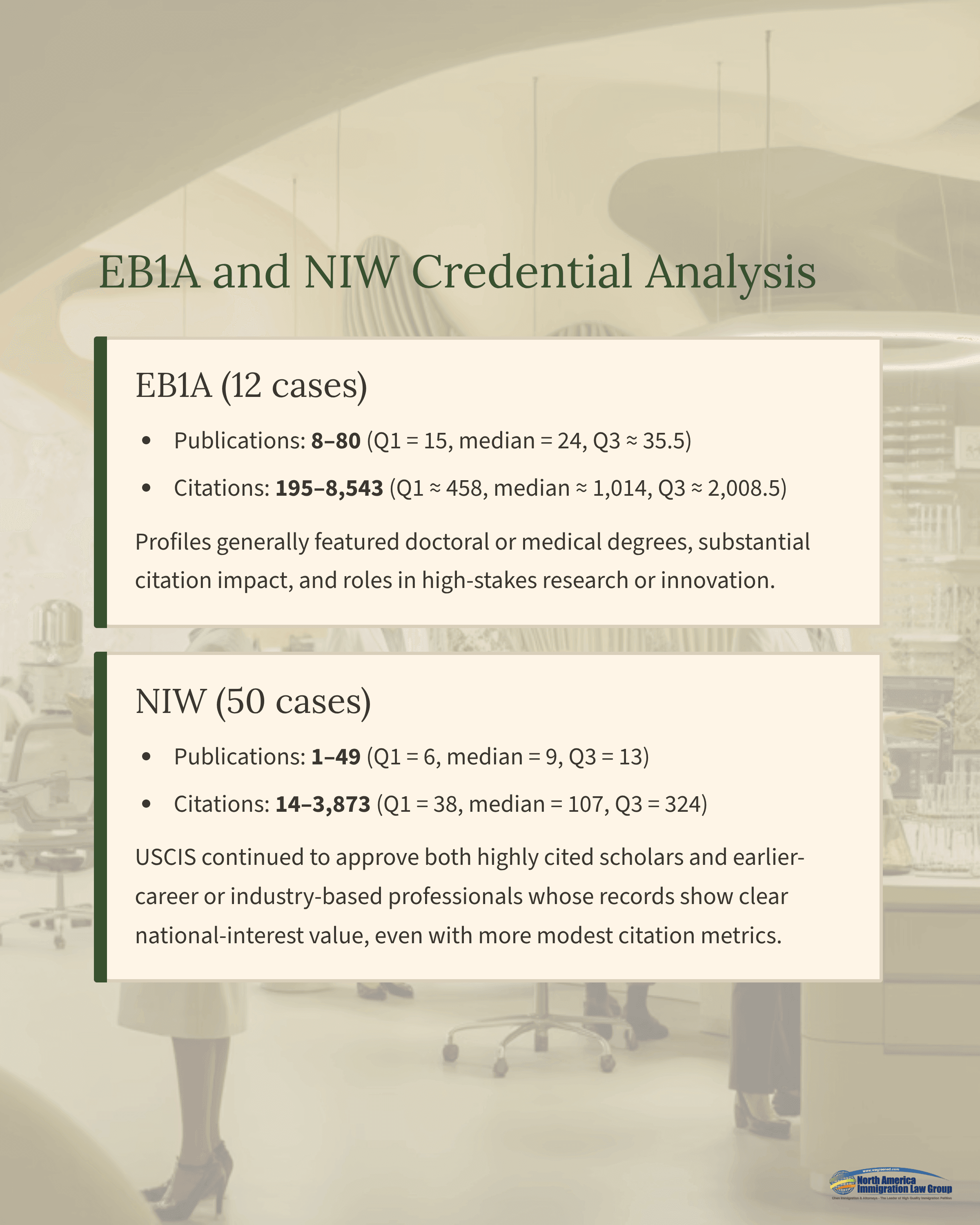
EB1A petitioners demonstrated strong and concentrated scholarly productivity, with publications ranging from 8 to 80 (Q1: 15, median 24, Q3 ≈ 35.5) and citations between 195 and 8,543 (Q1 ≈ 458, median ≈ 1,014, Q3 ≈ 2,008.5). These figures reflect substantial academic achievement and international impact, with most EB1A approvals clustering in the mid-teens to mid-thirties for publication counts and several hundred to a few thousand citations, along with a small number of highly cited outliers in the thousands. Almost all EB1A petitioners held doctoral or medical degrees and worked in STEM or clinically adjacent disciplines, often combining traditional academic records with leadership in high-stakes research or innovation projects.
NIW petitioners showed a broader range of academic and professional profiles. Publication counts ranged from 1 to 49 (Q1: 6, median 9, Q3: 13), and citations ranged from 14 to 3,873 (Q1: 38, median 107, Q3: 324). This distribution highlights USCIS’s flexibility in recognizing both well-established scholars whose metrics approach EB1A ranges and earlier-career or industry-based professionals whose work carries substantial merit and national importance, even when citation counts are modest. Most NIW petitioners held PhD or medical degrees, a substantial group held master’s-level credentials, and a smaller number qualified through advanced degrees combined with research-intensive roles or highly technical industry experience under the EB-2 standard.
Insights on Petitioner Backgrounds and Fields
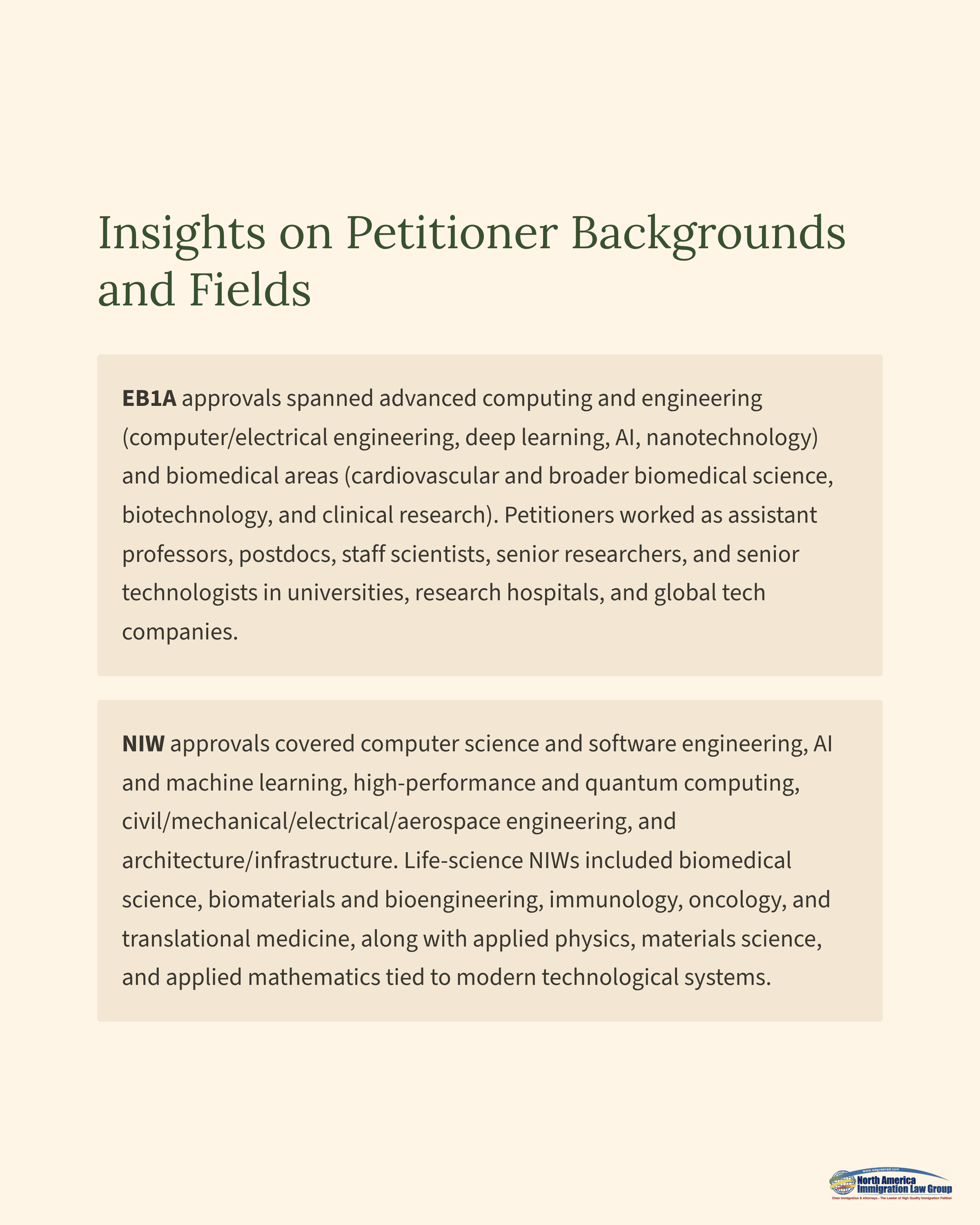
EB1A approvals this week spanned advanced computing and engineering, including computer engineering, electrical engineering, deep learning and artificial intelligence, and nanotechnology, as well as cardiovascular and broader biomedical science, biotechnology, and clinically oriented research. On the industry and infrastructure side, petitioners worked on high-performance computing, data-center systems, and other mission-critical platforms where technical innovation and operational reliability were crucial. Many EB1A petitioners served at universities and research institutes as assistant professors, postdoctoral fellows, staff scientists, and senior researchers, while others held distinguished technical or scientific roles in global technology companies, research hospitals, and specialized R&D organizations.
NIW approvals covered computer science and software engineering, artificial intelligence and machine learning, high-performance computing, quantum and advanced scientific computing, civil, mechanical, electrical, and aerospace engineering, and architecture and infrastructure-related fields. Life science and health-related NIW fields included biomedical science, biomaterials and bioengineering, immunology, oncology-related research, and broader clinical and translational medicine. Other nationally important areas included applied physics, materials science, and applied mathematics tied to modern technological systems. Profiles frequently included Ph.D. students, postdoctoral researchers, assistant professors, research scientists, applied scientists and engineers in industry, as well as clinicians and healthcare professionals whose projects align with U.S. priorities in AI and digital infrastructure, scientific competitiveness, energy efficiency, public health, and resilient critical systems.
Highlighted NIW Case: Early-Career AI Systems Engineer with Distinctive Impact Profile
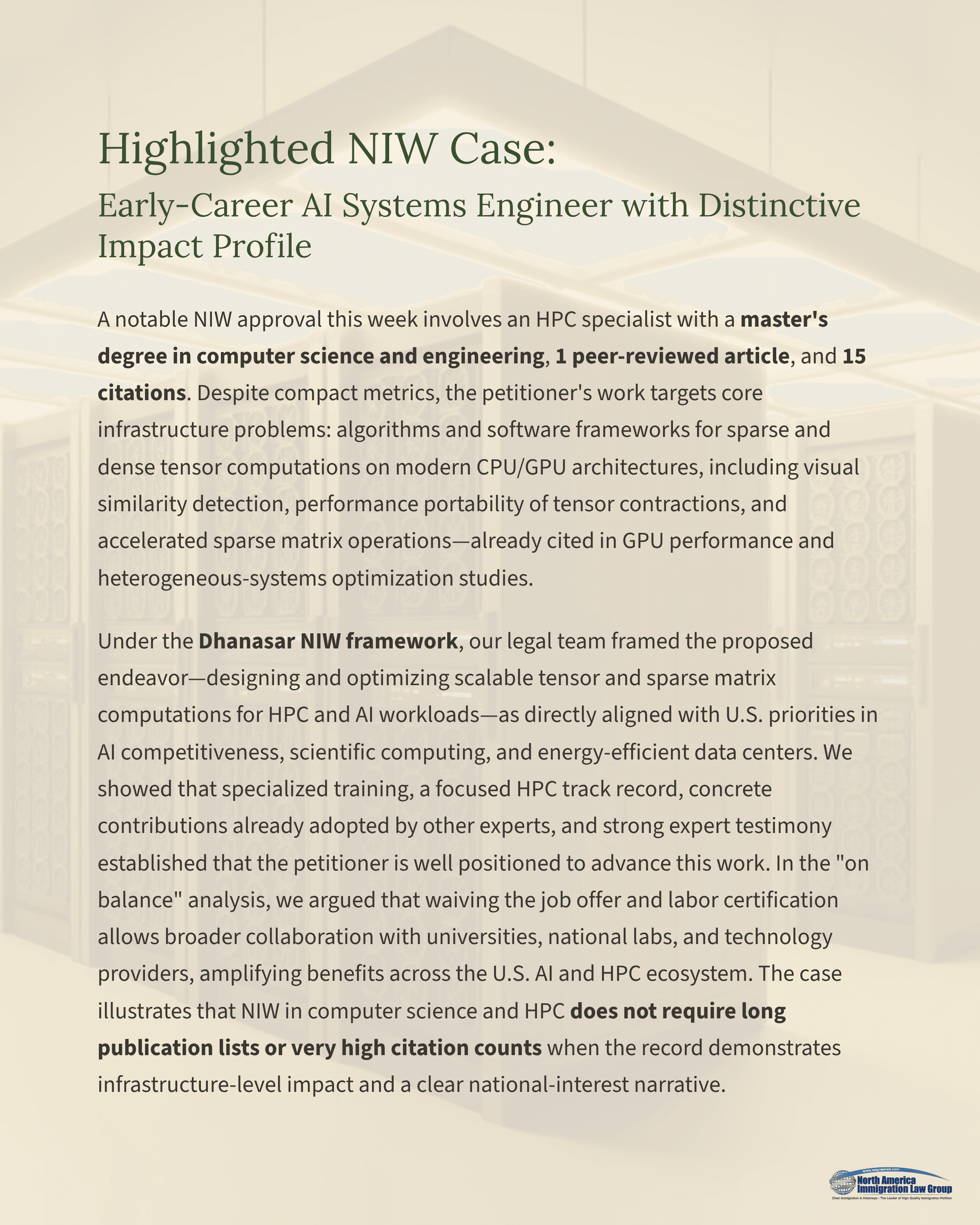
A standout NIW approval this week involves a high-performance computing (HPC) specialist whose profile differs from many traditionally high-citation computer science researchers. The petitioner holds a master’s degree in computer science and engineering and qualified for EB-2 on the basis of this advanced degree and specialized work in HPC. The publication record is compact—1 peer-reviewed article with 15 citations—but the underlying contributions are technically deep and infrastructure-focused. The petitioner’s work on algorithms and software frameworks for sparse and dense tensor computations on modern CPU and GPU architectures, including methods for visual similarity detection, performance-portability analyses of tensor contractions, and acceleration of sparse matrix computations, has already been cited in studies on GPU performance, software optimization for heterogeneous systems, and surveys of sparse inference engines for AI systems. This pattern of early uptake illustrates growing influence in a niche yet nationally important area of scientific and AI computing infrastructure.
Our legal team framed the case under the Dhanasar NIW framework by emphasizing how the proposed endeavor—designing and optimizing efficient, scalable tensor and sparse matrix computations for HPC and AI workloads—directly aligns with U.S. priorities in AI competitiveness, scientific computing capacity, and energy-conscious data-center operations. We showed that the petitioner is well positioned to advance this endeavor through specialized graduate training, a focused track record in HPC, concrete technical contributions already adopted by other experts, and strong expert support explaining how impact is measured in this field. In the “on balance” analysis, we argued that waiving the job offer and labor certification would allow the petitioner to collaborate flexibly with universities, national laboratories, and technology providers, amplifying benefits across the broader U.S. AI and HPC ecosystem rather than limiting contributions to a single employer. This result underscores that NIW in computer science and HPC is not reserved only for long publication lists or very high citation counts; a targeted infrastructure-level contribution, early evidence of external uptake, and a clear national-interest narrative can be equally decisive.
Adjudication Trends and Policy Observations
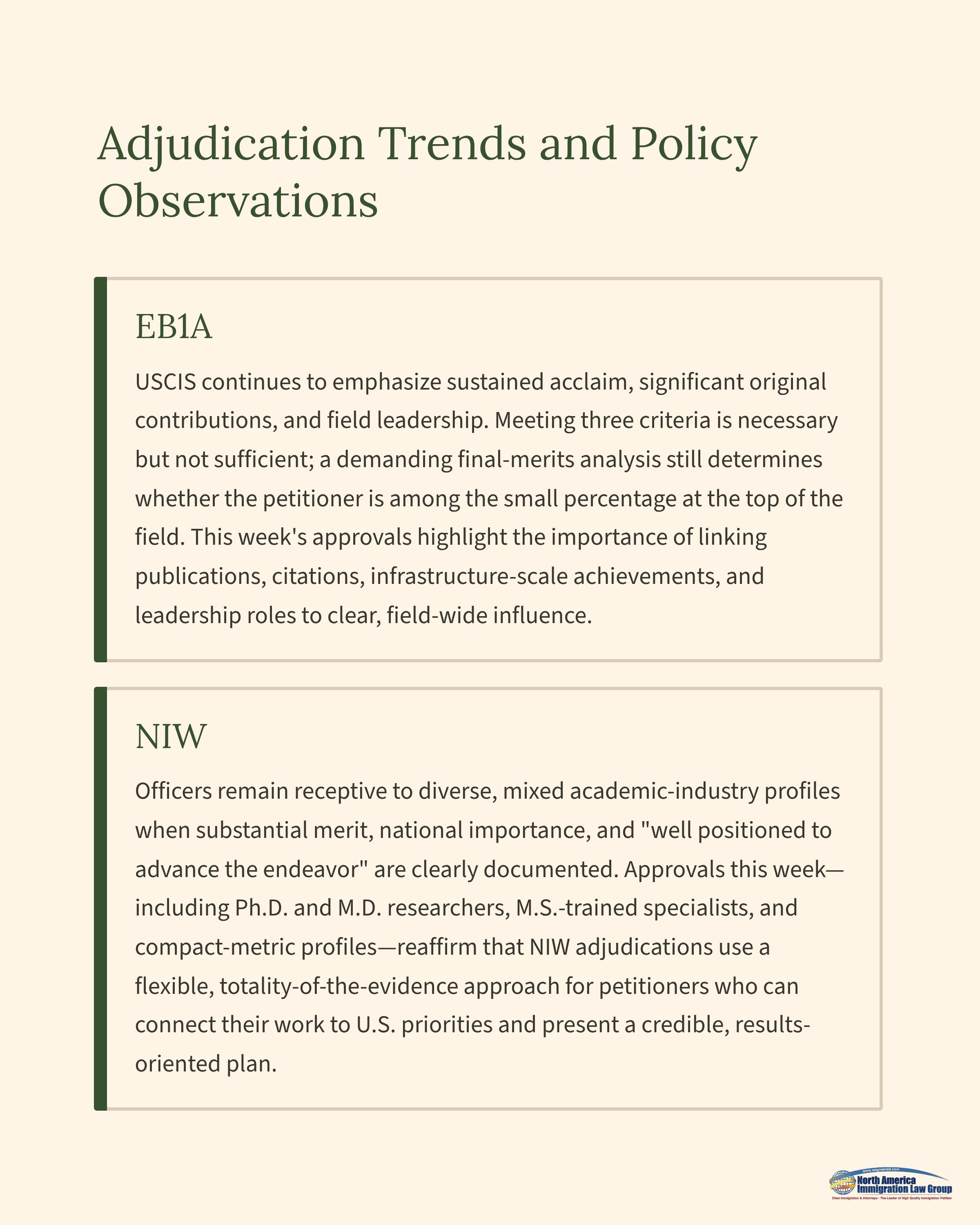
EB1A: USCIS continues to focus on sustained acclaim, significant original contributions, and leadership in the field. Meeting at least three of the EB1A regulatory criteria remains necessary but not sufficient; officers also conduct a rigorous final merits analysis to determine whether the petitioner ranks among the small percentage at the very top of the field. This week’s EB1A approvals, which include both traditional academic researchers and senior industry technologists, underscore the importance of presenting criterion-by-criterion documentation that connects publications, citations, infrastructure-scale achievements, and leadership roles to clear, field-wide influence rather than purely internal performance metrics.
NIW: Officers remain receptive to diverse academic and industry profiles when the record shows substantial merit, national importance, and that the petitioner is well positioned to advance the proposed endeavor. This week’s results—including approvals for Ph.D. and M.D. researchers, M.S.-trained specialists, and compact-metric profiles—reaffirm that NIW adjudications follow a flexible, totality-of-the-evidence approach. Petitioners who clearly connect their work to documented U.S. priorities and present a credible, results-oriented plan to move that work forward—even when their metrics differ from the typical profile in their field—are well positioned for success.