

WeGreened Approval Statistics: Week of November 3 , 2025
During the week of November 3 to November 9, 2025, WeGreened received 78 approval notices from U.S. Citizenship and Immigration Services (USCIS). Of the 78 approvals, 40 were for NIW (National Interest Waiver), 30 for EB1A (Alien of Extraordinary Ability), 4 for EB1B (Outstanding Professors or Researchers), and 4 for O1A (Individuals with Extraordinary Ability or Achievement). The EB-2 NIW category again represented the majority of approvals, while the EB-1A category maintained a strong presence among accomplished researchers and professionals.
EB1A and NIW Credential Analysis
EB1A petitioners demonstrated strong scholarly productivity, with publications ranging from 6 to 70 (median 17) and citations between 9 and 2,738 (median 889). These figures reflect substantial academic achievement and international impact.
NIW petitioners showed a broader range of academic profiles, with publication counts from 4 to 280 (median 9) and citations between 23 and 14,276 (median 141.5). This distribution highlights USCIS’s flexibility in recognizing both highly cited scholars and professionals whose work carries substantial merit and national importance.
Insights on Petitioner Backgrounds and Fields
EB1A approvals spanned artificial intelligence, data science, photonics and optical imaging, oncology, endocrinology, hematology, infectious disease epidemiology, wearable systems engineering, materials science, paleontology, and environmental science. Many petitioners worked at universities, research institutes, medical centers, or high-tech companies in roles such as postdoctoral fellow, research scientist, senior engineer, medical specialist, assistant professor, and industry R&D professional.
NIW approvals covered computer science, robotics and human-centered AI, computer engineering, aerospace engineering, biomedical science, biotechnology, cardiovascular disease research, public health, biostatistics, civil and mechanical engineering, biological physics, and quantitative finance, among others. Profiles frequently included industry engineers, applied scientists, clinicians, and Ph.D. candidates, with projects aligned to U.S. healthcare, infrastructure, energy, financial stability, and technology priorities.
Highlighted EB1A Case: Industry-Based Success in Data-Center Automation
A standout EB1A approval this week features a senior data-center automation specialist in advanced computing. With 6 first-authored peer-reviewed publications and 9 citations, the petition centered not on traditional academic metrics, but on verifiable technical and business outcomes: zero-downtime global data-center migrations, automation frameworks that boosted operational efficiency, reductions in energy use, disaster-recovery strategies that ensured extremely high uptime for critical applications, and tools that significantly cut manual decommissioning steps, lowering human error and audit risk.
Our legal team organized the evidence under the two-part Kazarian framework and demonstrated that multiple EB1A criteria were clearly met. First, we established original contributions of major significance by documenting how the petitioner’s automation solutions reshaped large-scale infrastructure practices and delivered measurable gains in reliability, efficiency, and sustainability. Second, we proved a leading and critical role at a distinguished global IT services company through proof of senior-level classification reserved for leadership roles, management of a large technical team, and responsibility for high-stakes modernization projects affecting thousands of servers. Third, we corroborated standing well above industry norms with evidence of peer-review and editorial-board service, professional media coverage discussing the petitioner’s work, and the scale and sensitivity of the infrastructure entrusted to the petitioner’s expertise. In the final merits analysis, we synthesized the commercialization outcomes, leadership record, and objective performance metrics to show sustained acclaim and that the petitioner ranks among the small percentage at the very top of the field.
This result is a practical reminder that academic citation counts are not the only measure of EB1A impact. When a petition clearly connects technical innovation, operational reliability, and critical leadership to verifiable outcomes at distinguished organizations, it can satisfy both the evidentiary criteria and the final merits test—even without a traditional research profile.
Adjudication Trends and Policy Observations
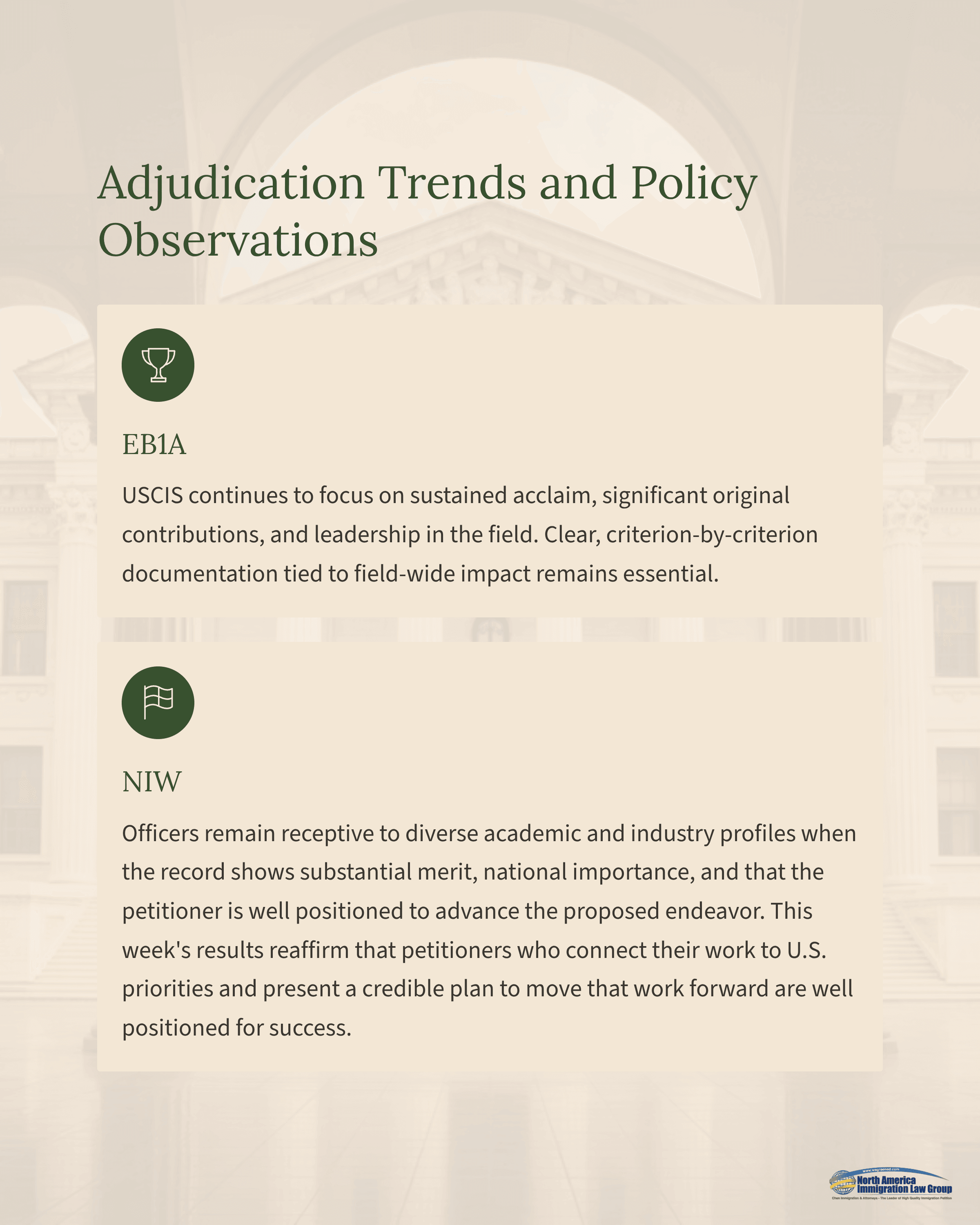
EB1A: USCIS continues to focus on sustained acclaim, significant original contributions, and leadership in the field. Clear, criterion-by-criterion documentation tied to field-wide impact remains essential.
NIW: Officers remain receptive to diverse academic and industry profiles when the record shows substantial merit, national importance, and that the petitioner is well positioned to advance the proposed endeavor. This week’s results reaffirm that petitioners who connect their work to U.S. priorities and present a credible plan to move that work forward are well positioned for success.