
WeGreened Approval Statistics: Week of September 15, 2025
During the week of September 15 to September 21, 2025, WeGreened received a total of 93 approval notices from the United States Citizenship and Immigration Services (USCIS). The EB-2 National Interest Waiver (NIW) category again represented the majority of approvals, while the EB-1A (Alien of Extraordinary Ability) category maintained a strong presence among accomplished researchers and professionals.
Approval Distribution by Category and Service Center
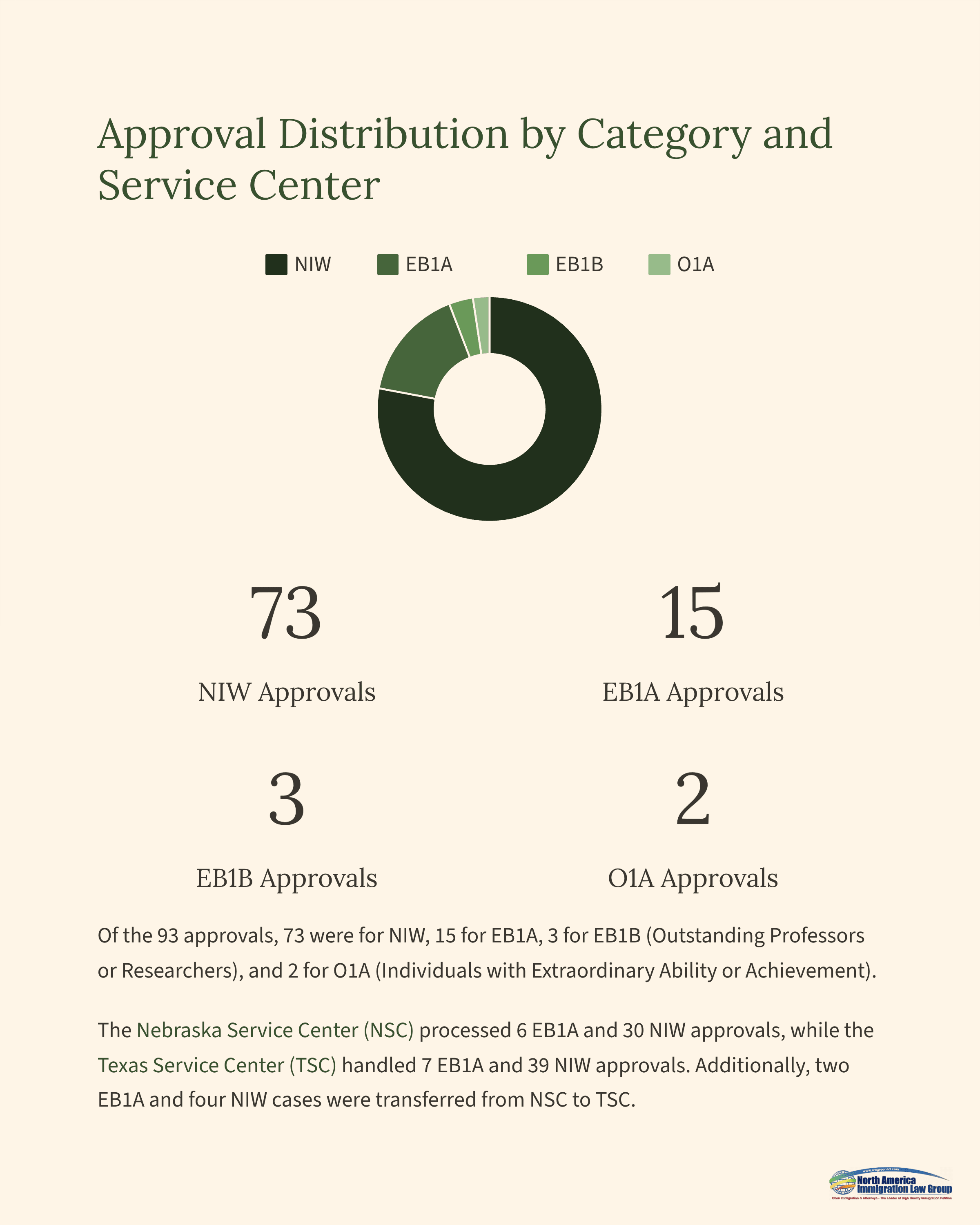
Of the 93 approvals, 73 were for NIW, 15 for EB1A, 3 for EB1B (Outstanding Professors or Researchers), and 2 for O1A (Individuals with Extraordinary Ability or Achievement).
The Nebraska Service Center (NSC) processed 6 EB1A and 30 NIW approvals, while the Texas Service Center (TSC) handled 7 EB1A and 39 NIW approvals. Additionally, two EB1A and four NIW cases were transferred from NSC to TSC.
EB1A and NIW Credential Analysis
EB1A petitioners demonstrated strong scholarly productivity, with publications ranging from 7 to 82 (median 19) and citations between 180 and 13,759 (median 631). These figures reflect substantial academic achievement and international impact.
NIW petitioners displayed a broader distribution of profiles, with publication counts from 3 to 114 (median 10) and citations between 12 and 2,108 (median 178). This variation underscores USCIS’s flexibility in adjudicating NIW petitions, emphasizing both research merit and practical contributions to U.S. priorities.
Insights on Petitioner Backgrounds and Fields
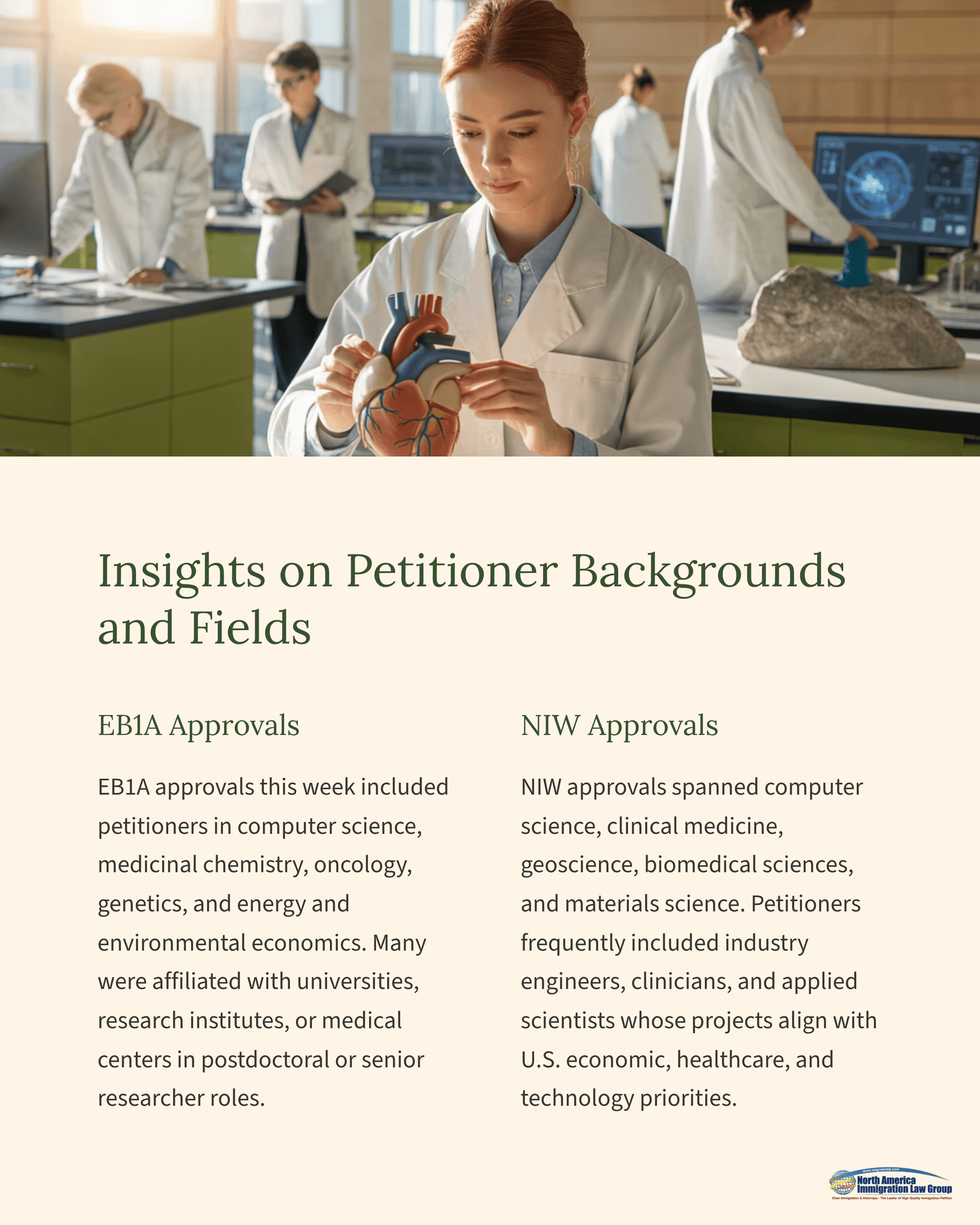
EB1A approvals this week included petitioners in computer science, medicinal chemistry, oncology, genetics, and energy and environmental economics. Many were affiliated with universities, research institutes, or medical centers in postdoctoral or senior researcher roles.
NIW approvals spanned computer science, clinical medicine, geoscience, biomedical sciences, and materials science. Petitioners frequently included industry engineers, clinicians, and applied scientists whose projects align with U.S. economic, healthcare, and technology priorities.
Highlighted NIW Case Without an Advanced Degree
One notable NIW approval this week involved a petitioner in Biomedical Engineering who did not hold an advanced degree. The record reflected 4 publications and 174 citations, and the case was adjudicated at the Nebraska Service Center. The petition was filed with premium processing and was approved in 5 days. Our legal team crafted a compelling case under the exceptional ability standard, demonstrating expertise significantly above that ordinarily encountered in the field.
We strategically selected evidence to satisfy at least three of the regulatory criteria, documenting the petitioner’s foundational training in biomedical engineering, membership in recognized professional associations, and peer recognition through publications and citations. We also emphasized the practical applications of the petitioner’s work in biosensors and point of care diagnostics, focusing on early disease detection and cardiovascular monitoring that deliver clear benefits for U.S. public health and healthcare sustainability.
To strengthen the national interest argument, we framed the research within U.S. priorities in health technology, biomanufacturing, and public health readiness, explaining how the petitioner’s methods improve diagnostic access and efficiency. We further contextualized the citation record by highlighting the influence of the petitioner’s most impactful publications and their uptake in translational research and product development.
This case highlights USCIS’s willingness to approve NIW petitions for individuals without advanced degrees when the record shows technical expertise significantly above the ordinary level and a clear capacity to advance U.S. national interests.
Adjudication Trends and Policy Observations
EB1A: USCIS continues to emphasize documented international recognition, significant original contributions, and leadership within the field.
NIW: Adjudicators remain open to diverse academic and industry profiles, approving cases that demonstrate clear U.S. national interest and the petitioner’s ability to advance their work.