

WeGreened Approval Statistics: Week of December 15, 2025
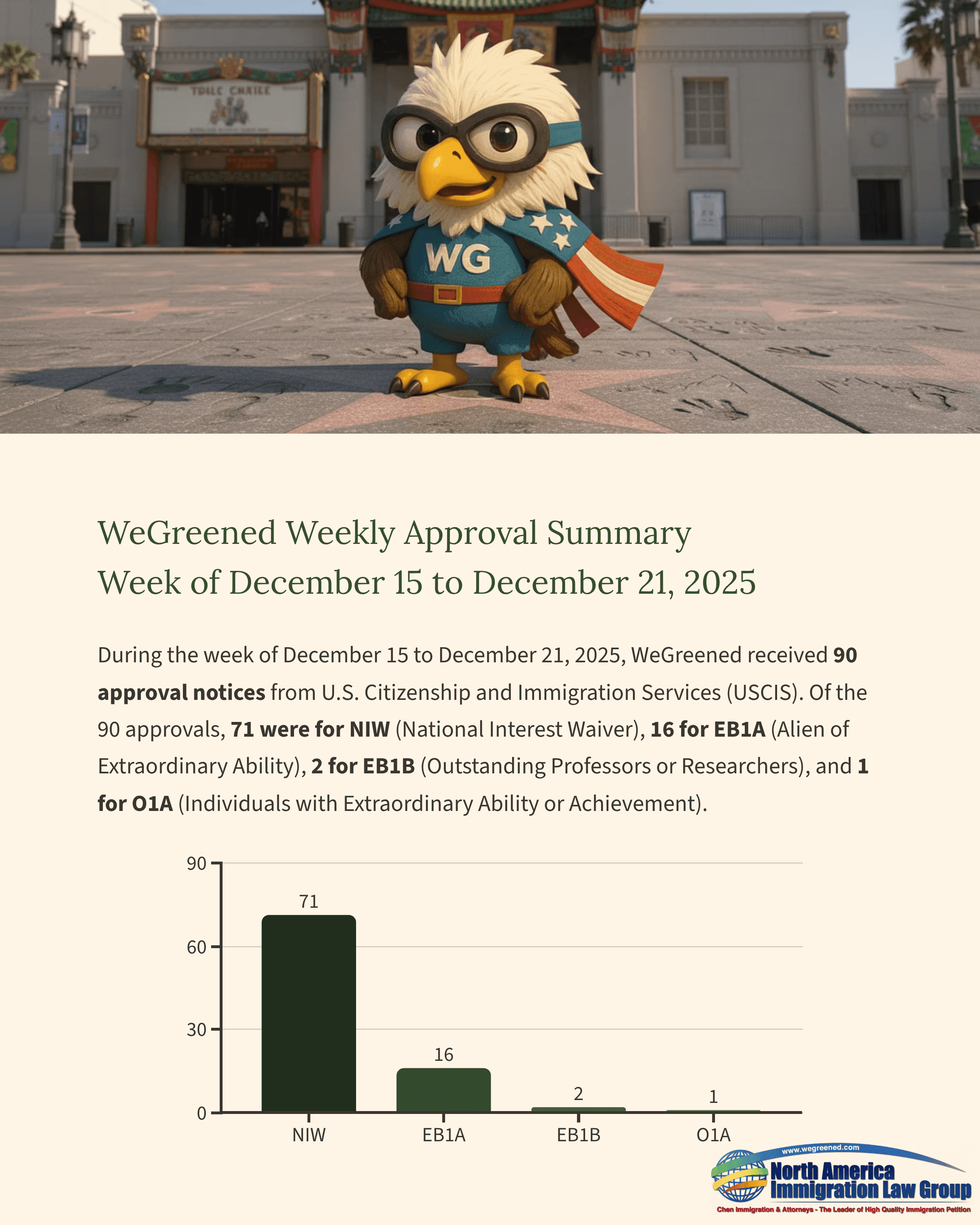
During the week of December 15 to December 21, 2025, WeGreened received 90 approval notices from U.S. Citizenship and Immigration Services (USCIS). Of the 90 approvals, 71 were for NIW (National Interest Waiver), 16 for EB1A (Alien of Extraordinary Ability), 2 for EB1B (Outstanding Professors or Researchers), and 1 for O1A (Individuals with Extraordinary Ability or Achievement).
The EB-2 NIW category again represented the majority of approvals, while EB-1A remained strong among professionals whose records supported sustained acclaim under a totality-of-the-evidence review.
EB1A and NIW Credential Analysis
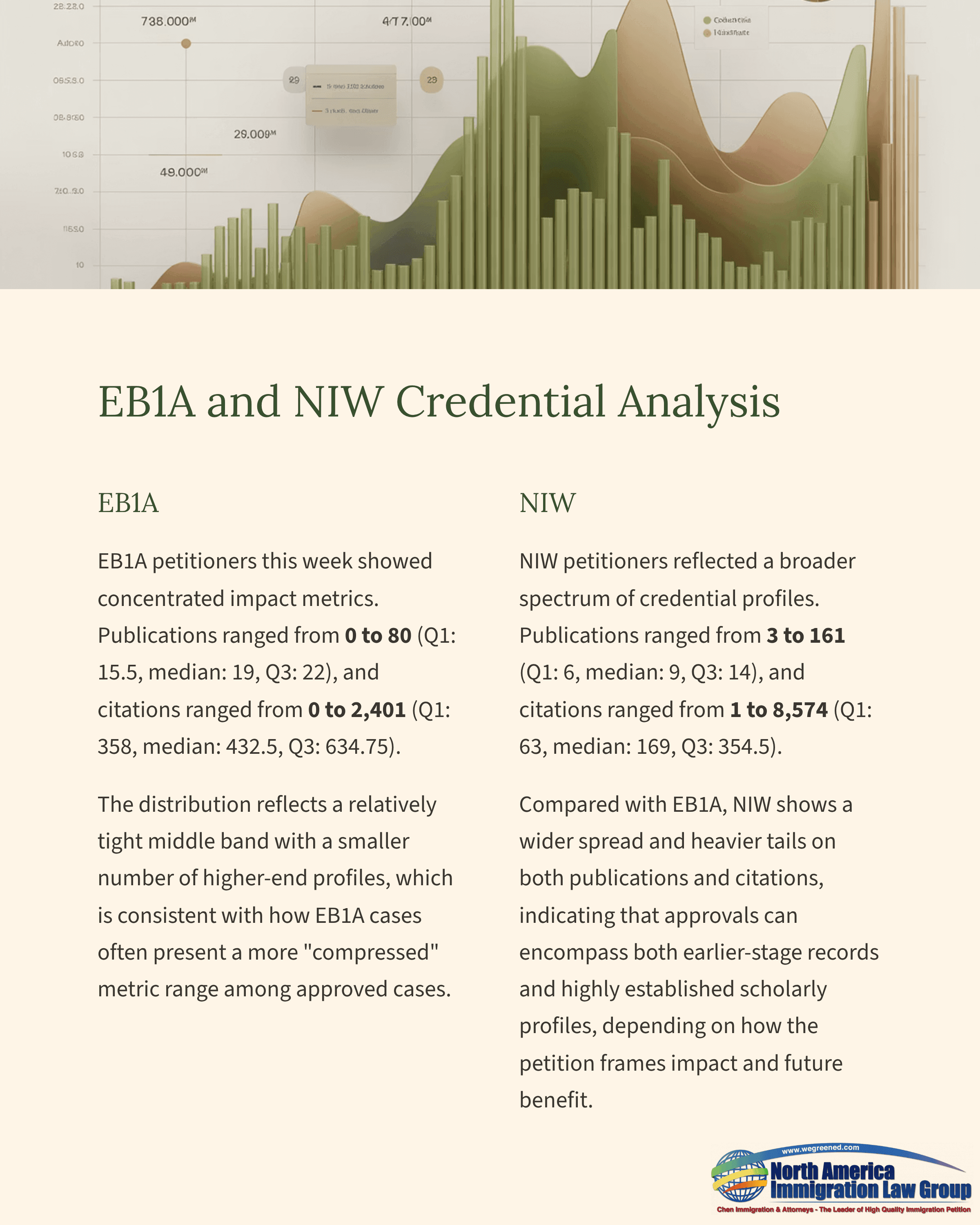
EB1A petitioners this week showed concentrated impact metrics. Publications ranged from 0 to 80 (Q1: 15.5, median: 19, Q3: 22), and citations ranged from 0 to 2,401 (Q1: 358, median: 432.5, Q3: 634.75). The distribution reflects a relatively tight middle band with a smaller number of higher-end profiles, which is consistent with how EB1A cases often present a more “compressed” metric range among approved cases.
NIW petitioners reflected a broader spectrum of credential profiles. Publications ranged from 3 to 161 (Q1: 6, median: 9, Q3: 14), and citations ranged from 1 to 8,574 (Q1: 63, median: 169, Q3: 354.5). Compared with EB1A, NIW shows a wider spread and heavier tails on both publications and citations, indicating that approvals can encompass both earlier-stage records and highly established scholarly profiles, depending on how the petition frames impact and future benefit.
Insights on Petitioner Backgrounds and Fields
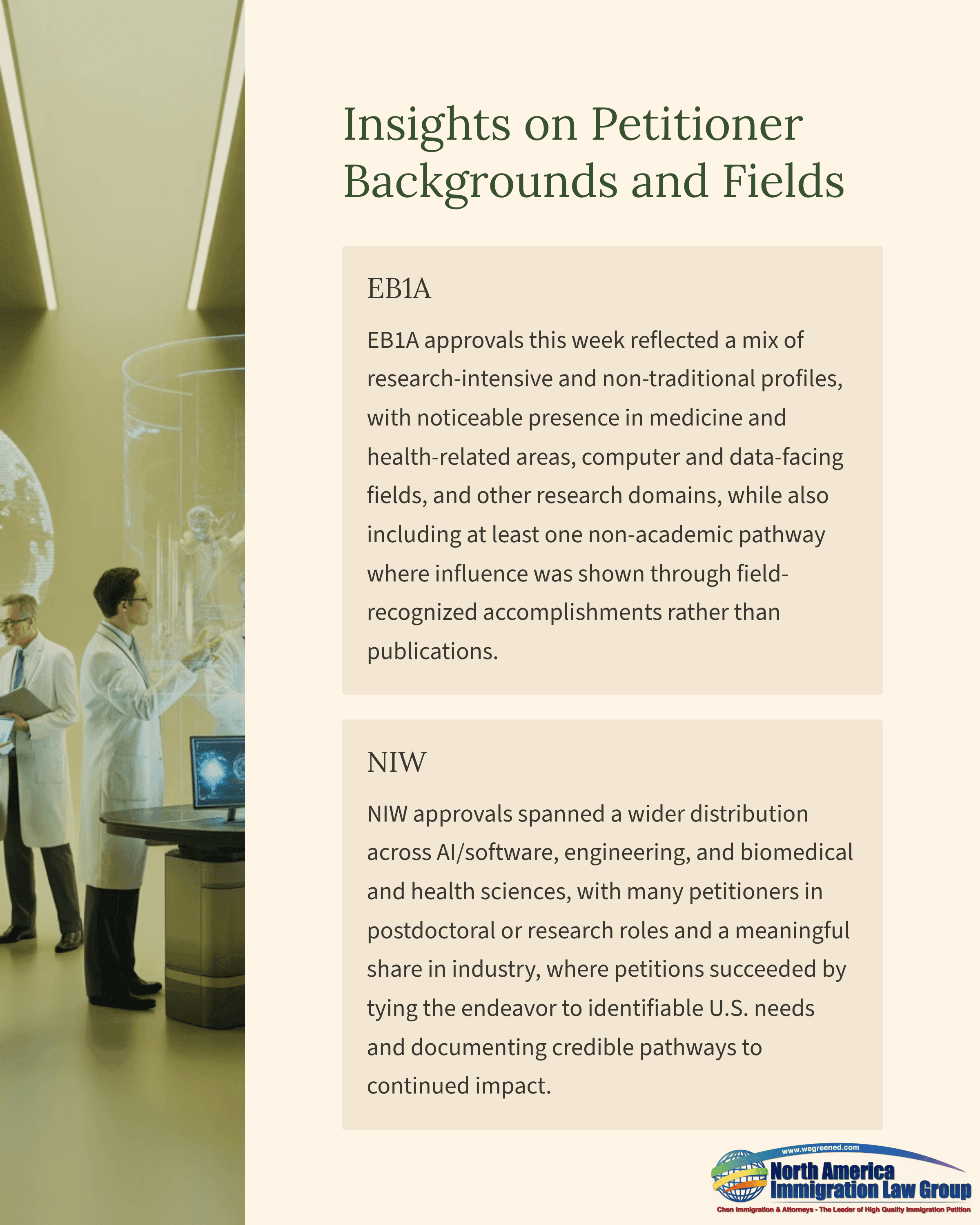
EB1A approvals this week reflected a mix of research-intensive and non-traditional profiles, with noticeable presence in medicine and health-related areas, computer and data-facing fields, and other research domains, while also including at least one non-academic pathway where influence was shown through field-recognized accomplishments rather than publications.
NIW approvals spanned a wider distribution across AI/software, engineering, and biomedical and health sciences, with many petitioners in postdoctoral or research roles and a meaningful share in industry, where petitions succeeded by tying the endeavor to identifiable U.S. needs and documenting credible pathways to continued impact.
Highlighted EB1A Case: High-Impact Journalism Leader Secured EB1A Without Academic Metrics
One notable EB1A approval this week involved a journalism professional pursuing a senior editorial strategy role at a major U.S. media organization. The petitioner holds a master’s degree, and the case was secured with a distinctly non-academic record that included no peer-reviewed publications and no citation record, demonstrating that extraordinary ability can be established through field-appropriate evidence of influence, recognition, and leadership. The case was filed with premium processing and approved in 120 days, and our team prepared four detailed expert recommendation letters to validate the petitioner’s standing and to translate field influence into the EB1A legal framework.
Our legal team organized the filing under the two-part Kazarian structure and demonstrated that multiple EB1A criteria were satisfied with objective, field-appropriate proof. We presented evidence of original contributions of major significance by documenting concrete influence on journalism practice and editorial strategy outcomes, supported by independent third-party validation. We also highlighted recognition in the form of awards and distinctions reflecting selectivity and professional significance, and we documented high remuneration by contextualizing compensation against relevant peer benchmarks in the field. In addition, we supported leading or critical role elements by showing the level of responsibility and the distinguished reputation of the organizations involved. In the final merits analysis, we synthesized these components into a single narrative demonstrating sustained acclaim and a record placing the petitioner among the small percentage at the very top of the field.
This outcome reinforces a point: EB1A success depends on presenting the strongest available, field-appropriate evidence and tying it together persuasively under final merits, even when traditional academic metrics are not central to the profession.
Adjudication Trends and Policy Observations
EB1A continues to turn on sustained acclaim and final merits review, where meeting at least three criteria is necessary but not sufficient. This week’s approvals also highlight that EB1A is not limited to academic metrics, including a non-academic journalism approval built without peer-reviewed publications or citation metrics and instead supported by field-appropriate evidence of influence, recognition, critical roles, and strong third-party validation.
NIW approvals again span a wide range of disciplines and career stages when the petition clearly defines a nationally important endeavor, shows the petitioner is well-positioned, and explains how a waiver amplifies U.S. benefit through flexibility and scale. In this batch, a noticeable share of approvals involved cases that used premium processing. When it was used, it more often appeared as an upgrade after filing rather than as an upfront request, but the consistent throughline remained the quality of the evidentiary record and the clarity of the Dhanasar framing rather than any single procedural choice.