

WeGreened Approval Statistics: Week of December 22, 2025
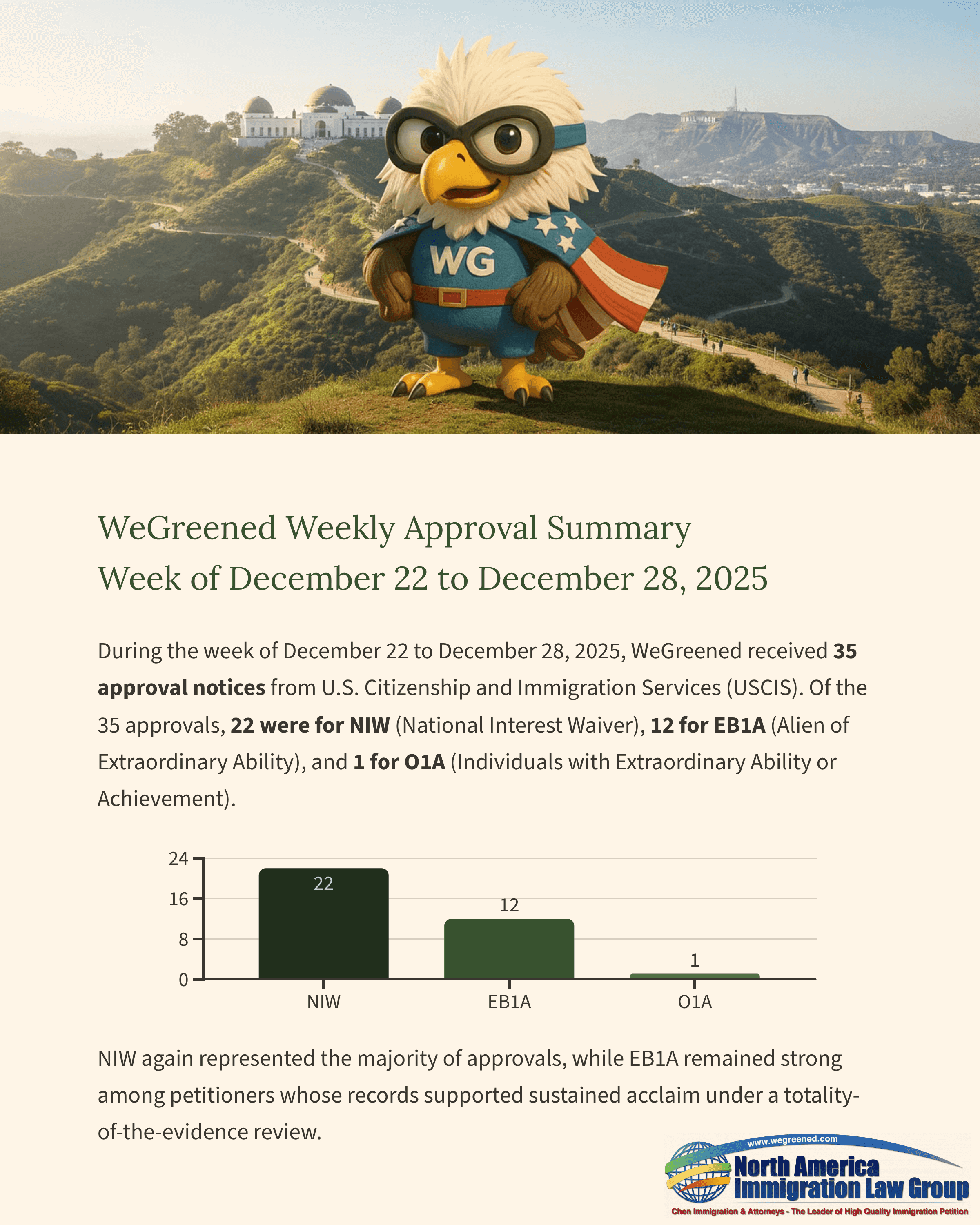
During the week of December 22 to December 28, 2025, WeGreened received 35 approval notices from U.S. Citizenship and Immigration Services (USCIS). Of the 35 approvals, 22 were for NIW (National Interest Waiver), 12 for EB1A (Alien of Extraordinary Ability), and 1 for O1A (Individuals with Extraordinary Ability or Achievement).
NIW again represented the majority of approvals, while EB1A remained strong among petitioners whose records supported sustained acclaim under a totality-of-the-evidence review.
EB1A and NIW Credential Analysis
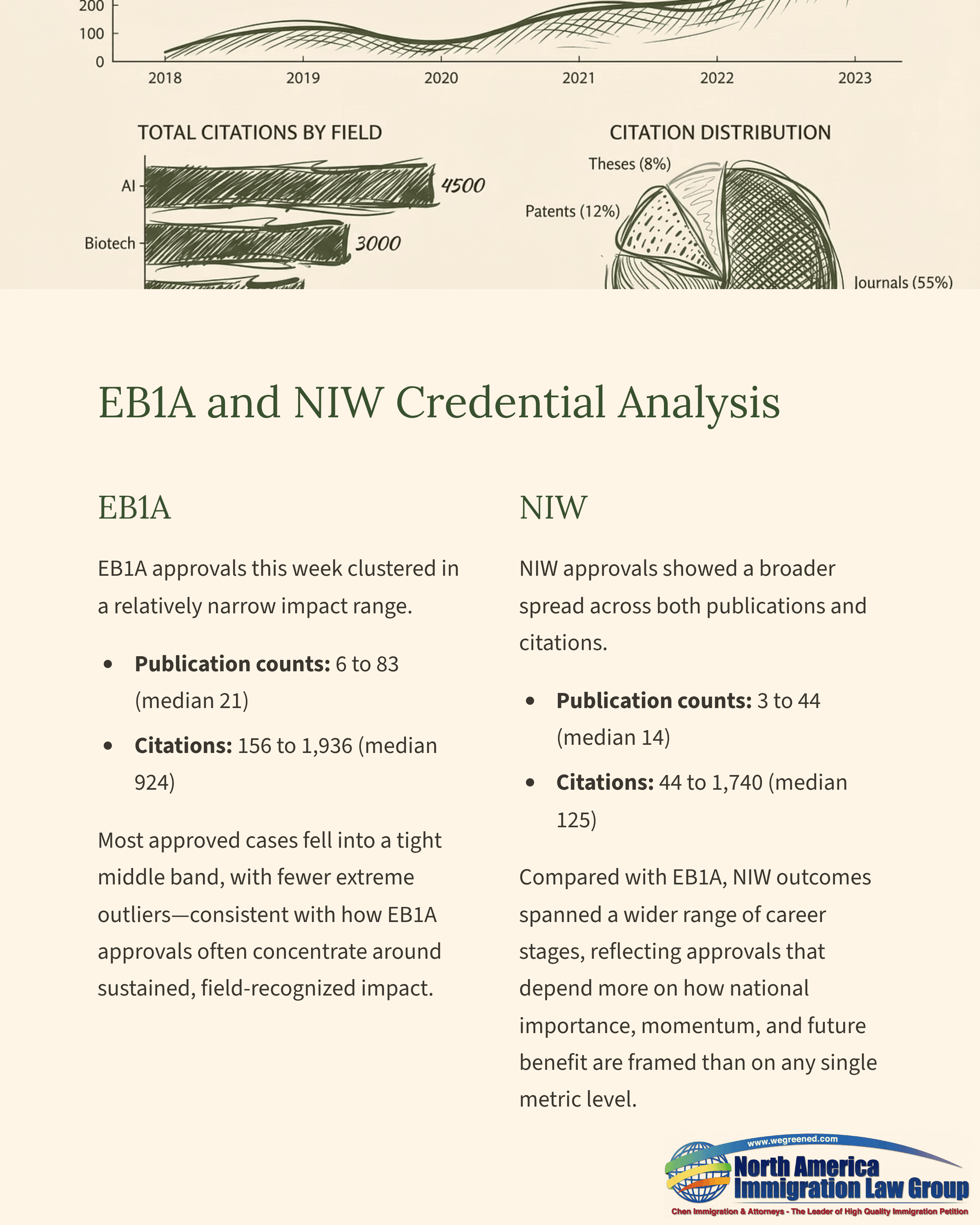
EB1A petitioners this week showed concentrated impact metrics. Publications ranged from 6 to 83 (Q1: 13.8, median: 21, Q3: 43), and citations ranged from 156 to 1,936 (Q1: 341.8, median: 924.5, Q3: 1,461.5). The distribution reflects a relatively tight middle band with a smaller number of higher-end profiles, which is consistent with how EB1A cases often present a more “compressed” metric range among approved cases.
NIW petitioners reflected a broader spectrum of credential profiles. Publications ranged from 3 to 44 (Q1: 6.3, median: 14, Q3: 19.8), and citations ranged from 44 to 1,740 (Q1: 68, median: 125, Q3: 265). Compared with EB1A, NIW shows a wider spread on both publications and citations, indicating that approvals can include both earlier-stage records and more established scholarly profiles, depending on how the petition frames national importance, forward momentum, and future U.S. benefit.
Insights on Petitioner Backgrounds and Fields
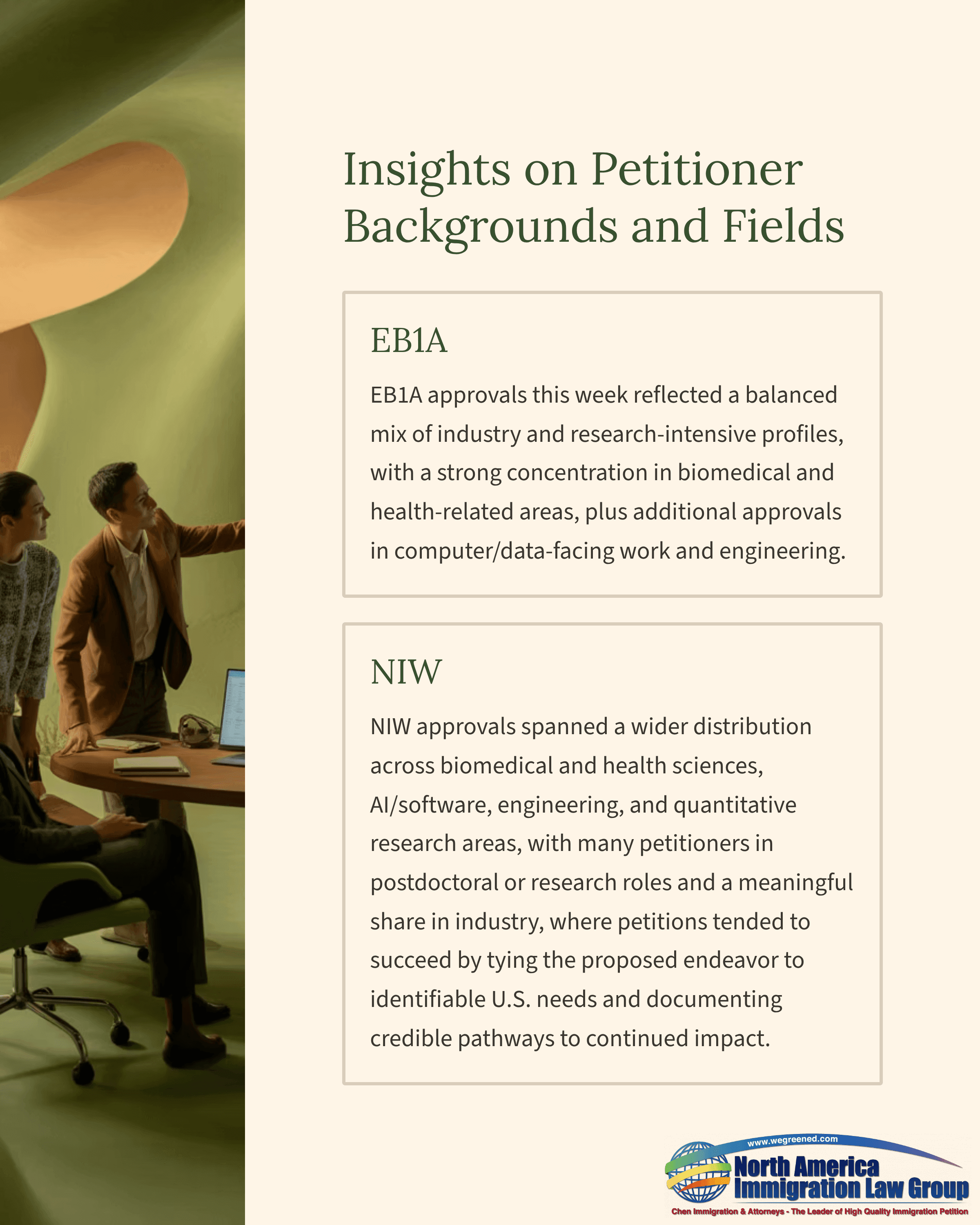
EB1A approvals this week reflected a balanced mix of industry and research-intensive profiles, with a strong concentration in biomedical and health-related areas, plus additional approvals in computer/data-facing work and engineering.
NIW approvals spanned a wider distribution across biomedical and health sciences, AI/software, engineering, and quantitative research areas, with many petitioners in postdoctoral or research roles and a meaningful share in industry, where petitions tended to succeed by tying the proposed endeavor to identifiable U.S. needs and documenting credible pathways to continued impact.
Highlighted NIW Cases: Two PhD Engineering Researchers Approved with Modest Citation Counts
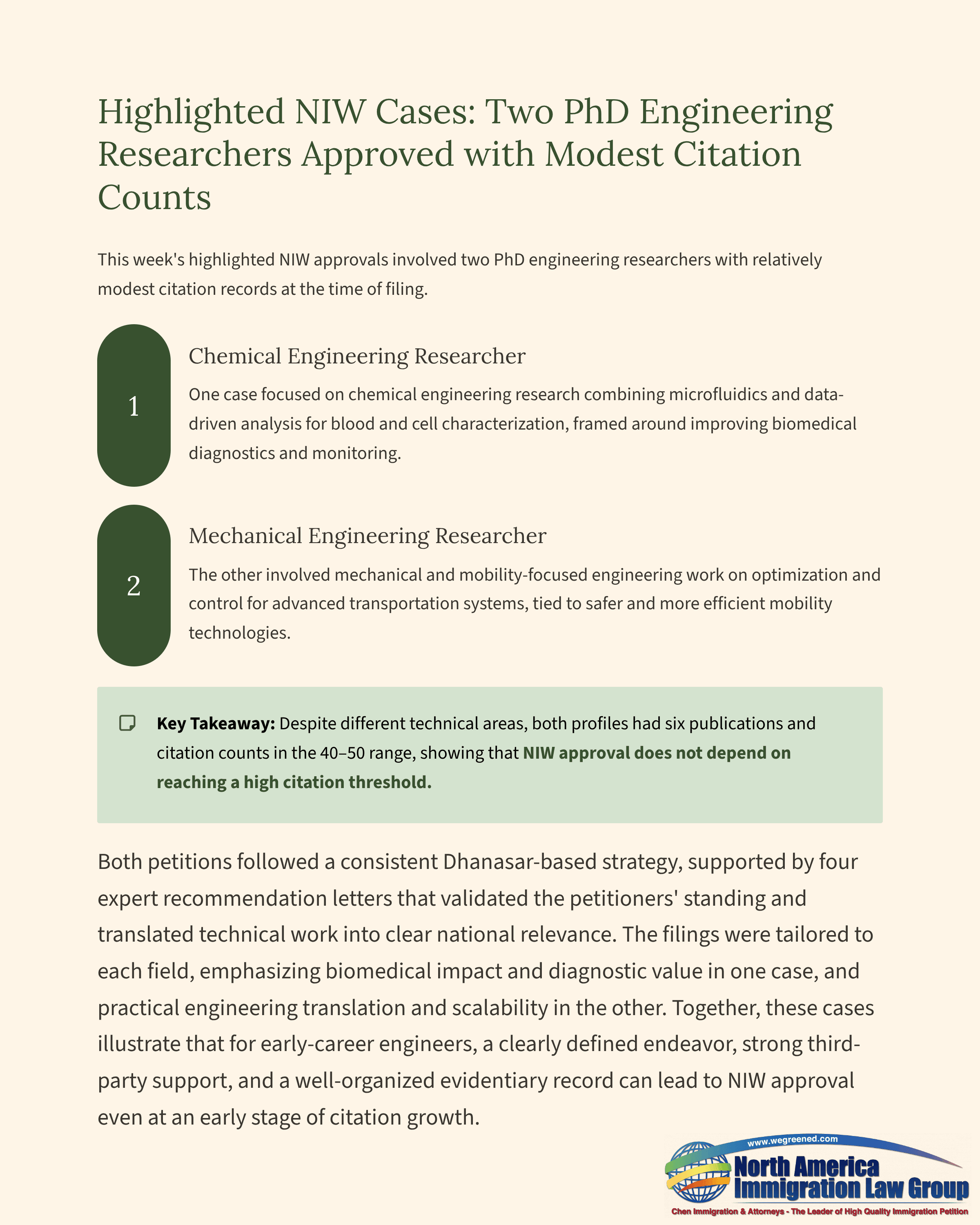
Two NIW approvals this week stand out because both petitioners were PhD students in engineering with relatively modest citation totals at the time of filing, yet were approved based on a tightly framed Dhanasar narrative and strong third-party support. One case involved a chemical engineering researcher working at the intersection of microfluidics and data-driven analysis for blood and cell characterization, positioning the proposed endeavor around improving diagnostic and monitoring capabilities in biomedical settings. The other involved a mechanical and mobility-oriented engineering researcher focused on optimization and control for advanced transportation systems, tying the endeavor to safer, more efficient mobility technologies and scalable engineering deployment pathways. Despite the different technical directions, both profiles had six publications and citation counts in the double digits (roughly in the 40–50 range), underscoring that NIW success does not require a high citation threshold when the petition’s logic and evidence are well aligned.
From a strategy perspective, both filings used a consistent core approach while emphasizing different strengths. In both cases, we prepared four expert recommendation letters to validate standing and to translate technical contributions into clear, officer-friendly significance. We then organized the petition prong-by-prong under the Dhanasar framework, first defining a narrowly scoped, nationally relevant endeavor, then showing the petitioner was well positioned through concrete indicators of progress and expertise, and finally explaining how a waiver would increase U.S. benefit by enabling flexibility, collaboration, and broader dissemination beyond a single employer.
Where the approach differed was in how we tailored the “well positioned” and “impact” analysis to each technical context. For the microfluidics and bioengineering-focused case, the petition leaned into technical validation, cross-disciplinary relevance, and practical diagnostic value, emphasizing how the research direction maps to measurable biomedical needs. For the mobility systems case, the petition leaned more heavily into engineering translation, showing how the petitioner’s work aligns with real-world deployment constraints and why the proposed direction is feasible, scalable, and likely to generate continued U.S. benefit. Together, these outcomes highlight a recurring NIW lesson for early-career engineers: when the endeavor is clearly defined and the evidence is organized to show credible momentum and a realistic pathway to impact, approval can be achievable even before citation totals become large.
Adjudication Trends and Policy Observations
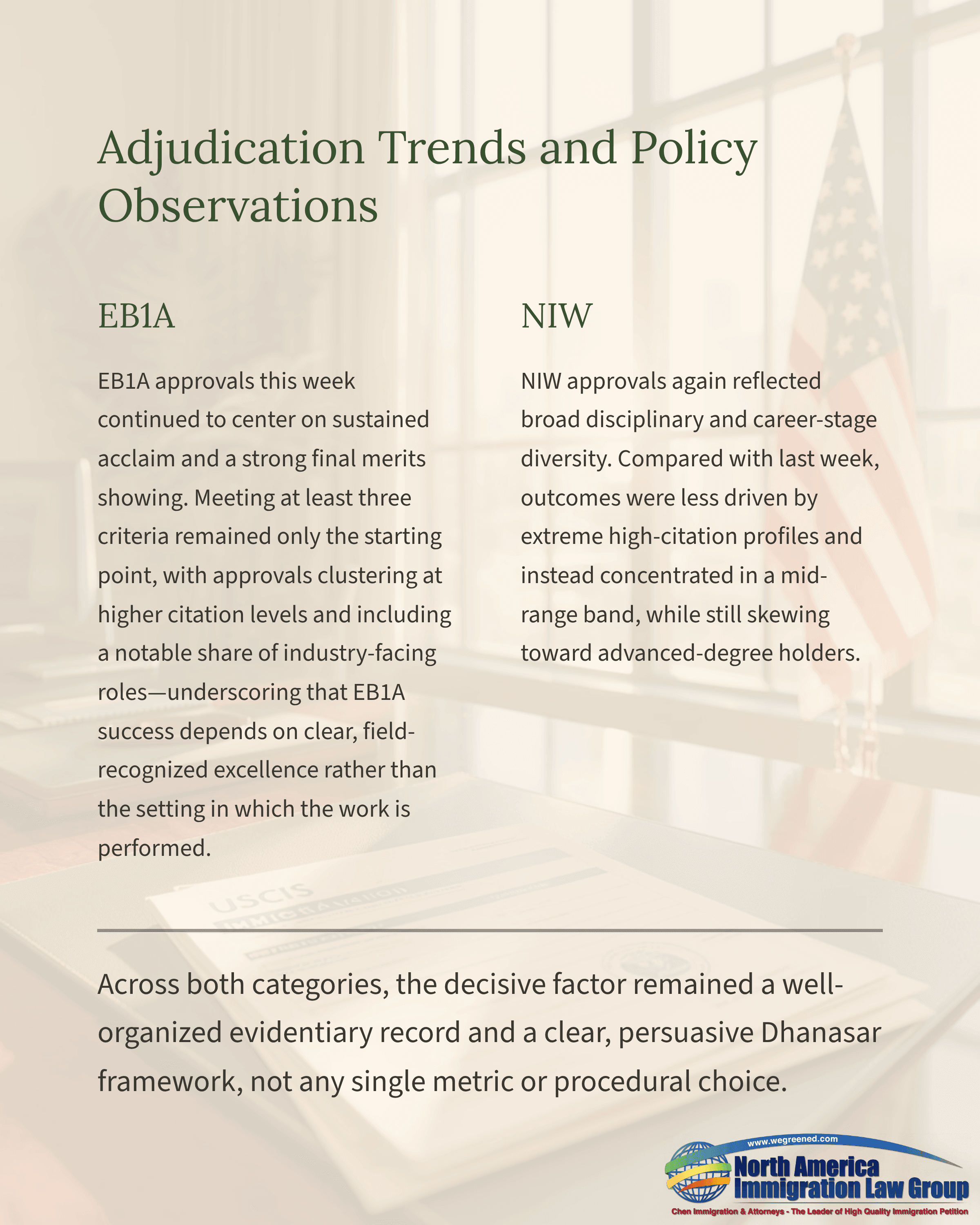
EB1A continues to turn on sustained acclaim and final merits review, where meeting at least three criteria is necessary but not sufficient. This week’s EB1A approvals clustered at higher citation levels than the prior week, consistent with how officers weigh field-wide influence under the totality of the record. EB1A outcomes also included a meaningful share of industry-facing roles, reinforcing that final merits depend less on where the work occurs and more on whether the evidence demonstrates sustained, field-recognized excellence.
NIW approvals again spanned a wide range of disciplines and career stages when the petition clearly defines a nationally important endeavor, shows the petitioner is well-positioned, and explains how a waiver amplifies U.S. benefit through flexibility and scale. Compared with last week, this week’s NIW approvals were less driven by extreme high-citation outliers and instead clustered more in a mid-range band, while still reflecting strong advanced-degree representation. Across the batch, the consistent throughline remained the quality of the evidentiary record and the clarity of the Dhanasar framing rather than any single metric or procedural choice.